
1-805-484-2992
Quotes - Engineering - SalesThe Medium Sets the Surface Temperature
Heating duty divides into two questions. What is the medium, and does the thing being heated tolerate the surface temperature that medium produces? Almost every heating problem we are sent turns on the second one.
The second of those two questions is what separates the duties below. A utility stream tolerates a hot surface; a product stream burns onto it. That single distinction is why steam duty is mostly a control problem, glycol duty is a pumping problem, and product duty is a surface-temperature problem with a cleaning requirement attached to it.
- Steam to water. A temperature difference large enough that the selection is about controlling it rather than achieving it, which makes the control valve and the exchanger one design rather than two.
- Hot water and glycol. Closed loop, modest difference, undemanding until glycol enters it — at which point viscosity changes both the heat transfer and the pumping, so state the concentration.
- Product and ingredient heating. The stream is valuable, often viscous and frequently shear sensitive, and it will burn onto any surface hotter than it should be.
- CIP solution heating. Aggressive chemistry brought to setpoint quickly, in an exchanger that then has to be cleaned itself. One of the few duties where the unit is both the tool and the thing being cleaned.
- A close approach buys medium temperature. Reaching within a few degrees lets a cooler medium do the same work, which is what makes recovered heat or low-pressure steam usable on a duty that looks like it needs more.
- Say which constraint binds. If the medium is fixed we hold the surface temperature; if the outlet is contractual we will say what it costs in medium temperature. A selection made without knowing which one binds is a guess.


What Decides the Selection
The heating medium and its temperature, the flow and required outlet temperature of the heated stream, the allowable pressure drop, and whether the stream fouls. On product duty the surface temperature the medium produces matters more than its bulk temperature, because burn-on happens at the wall.
Why Mueller Suits Heating Duty
A plate pack gives a very close temperature approach, so a lower-temperature medium can still deliver the duty, which is exactly what protects a heat-sensitive product. Where the thing being heated is in a tank rather than a pipe, Temp-Plate puts the surface inside or outside the vessel instead.
Process Heating

Steam-to-Water Heating
Steam on one side, water on the other, and a temperature difference large enough that the exchanger selection...
+ Learn More
Hot Water & Glycol
Closed loop, liquid to liquid, modest temperature difference. The design is undemanding until glycol enters...
+ Learn More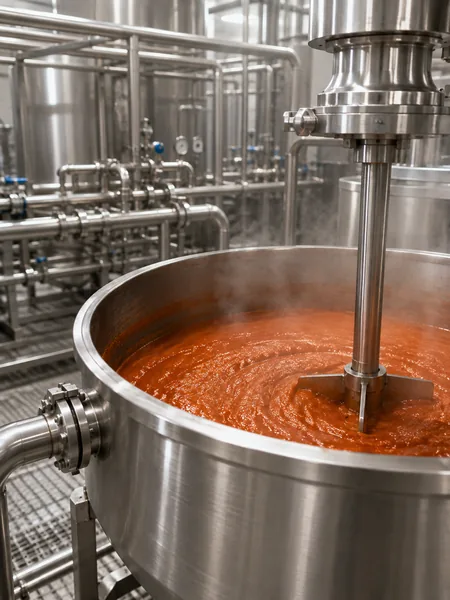
Product & Ingredient Heating
Heating the product itself is a different problem from heating a utility. The stream is valuable, often...
+ Learn MoreBefore you size
Tell us which, because it reverses the design logic. When the plant sets the medium, we work out the wall temperature it will produce and add surface to keep that wall acceptable. When the outlet temperature is the hard number, we show what medium temperature it takes and what that means for fouling.
Viscosity at the inlet and outlet temperatures comes first, along with the temperature at which the product starts to scorch, set or denature. Specific heat and density are often close enough from a handbook, but viscosity on real product can be several times the textbook value. Lab data at two or more temperatures takes most of the guesswork out of the plate choice.
A plate pack sized for full flow can drop into laminar flow at low rates, and on steam the control valve then works near its seat and the outlet temperature hunts. Give us the lowest flow the heater will see as well as the highest. Knowing the range up front lets us split the duty, change the pass arrangement or size the valve for both ends.
State the fouling you actually see between cleans, and we size so the outlet temperature still holds at the end of a run. Piling on margin as a blanket percentage tends to backfire, since the oversized unit runs slow when clean and gathers deposit faster. On product duty, the cleaning interval you want is a better input than any fouling factor.