
1-805-484-2992
Quotes - Engineering - SalesTemp-Plate Immersion Assembly
Heat Transfer Inside the Vessel
An immersion assembly is a set of Temp-Plate panels fabricated into a rack that hangs inside the vessel, with the heating or cooling medium circulating through the panels. Double embossed panels are normally recommended, since both faces then contribute surface.
When it is the right answer. When the process fluid cannot be pumped through an external exchanger. When design pressures or temperatures are high. When the environment is highly corrosive and a fully welded assembly in an exotic alloy is the only thing that survives. And when the process needs a low level of surface disturbance in the tank.
What it gives you over a coil. Continuous wall-to-wall surface instead of line contact along a tube, lower media volume to pump, and a shape that can be built to suit the tank rather than coiled to fit it.
Practical detail. Support, thermal expansion of the rack, and how the assembly is removed for cleaning all have to be designed rather than assumed. So does the connection arrangement through the tank wall or over the top.
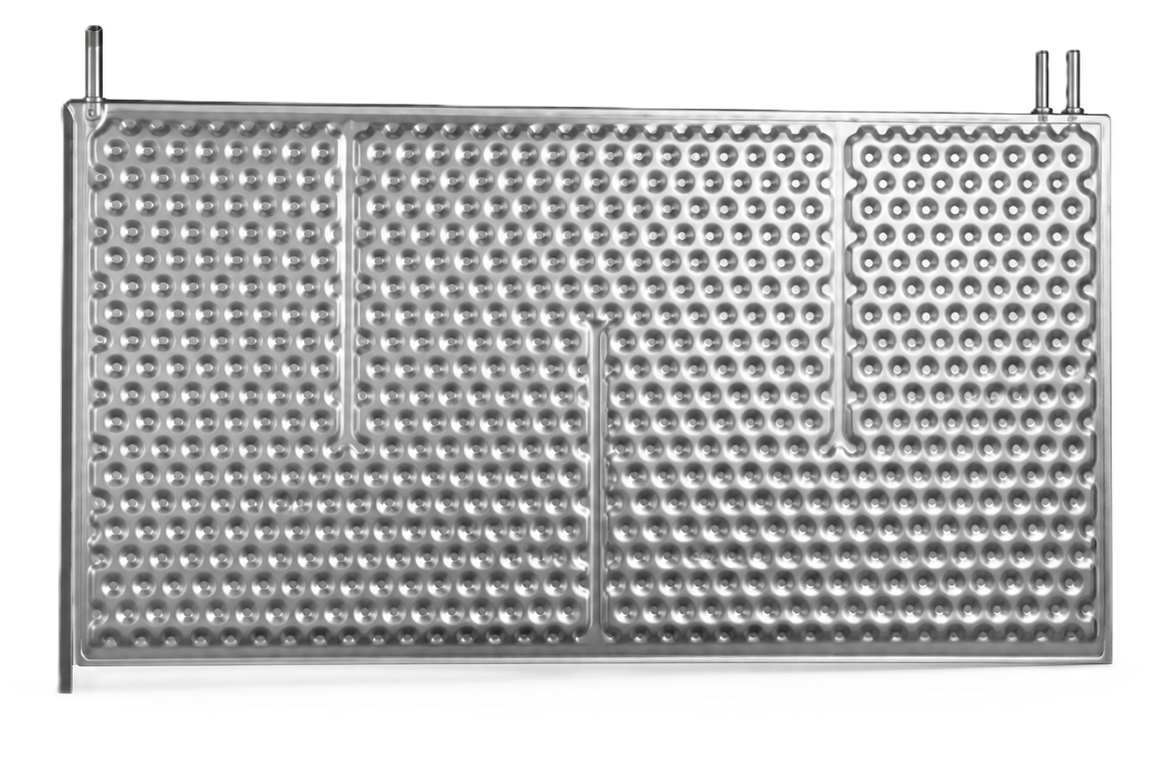
Typical Specification
- Panel type: Double embossed recommended for immersion
- Materials: 304 and 316 stainless, carbon steel, titanium, high alloys
- Media: Steam, hot oil, hot water, glycol, chilled water, refrigerant
- Construction: Fully welded; no gaskets or replaceable parts
- Surface: Continuous both faces; wall-to-wall contact with the fluid
- Media volume: Lower than traditional dimple jacketing
- Design pressure: Engineered to the specified duty
- Mounting: Suspended rack, wall mounted or floor supported
- Removal: Designed for lift-out cleaning where required
- Typical duty: Plating tanks, pickling, chemical batch, food vats
| PRODUCT | CONSTRUCTION | MATERIALS | SUPPLY |
| Temp-Plate Immersion Assembly | Mueller factory built | 304 / 316 stainless | Authorized representative |
Temp-Plate Immersion Assembly
Sizing Against Natural Convection
Most immersion duty has no forced circulation on the tank side, so heat moves by natural convection. That gives a much lower coefficient than a pumped exchanger and it is why immersion assemblies carry a lot of surface for a modest duty.
Where agitation exists, say so. An agitated tank transfers far better than a still one and the assembly gets smaller accordingly.
Corrosive Service
A fully welded assembly with no gaskets is a significant advantage in aggressive chemistry, because there is no elastomer to attack. Material selection then follows the fluid rather than the seal.
Plating, pickling and acid tanks are common homes for immersion Temp-Plate for exactly this reason, frequently in higher alloys or with specialised finishes.
Common FAQs
When the process fluid cannot practically be pumped out and back. Viscous products, abrasive slurries, batch processes that must not be disturbed, and tanks where adding pumps and pipework is not welcome are all candidates.
It can be designed that way, and on food and product duty it usually should be. Tell us at design stage so the connections, supports and lifting arrangement are built for removal rather than being welded in place.
Steam, hot water, hot oil, glycol, chilled water or refrigerant. The panel is a designed pressure boundary, so the medium and its pressure and temperature form part of the design input.
Temp-Plate gives continuous surface across the whole panel face rather than contact only along a tube. It also needs less media volume pumped through it. A coil still has a place at very high media pressure or in very small tanks.
Related
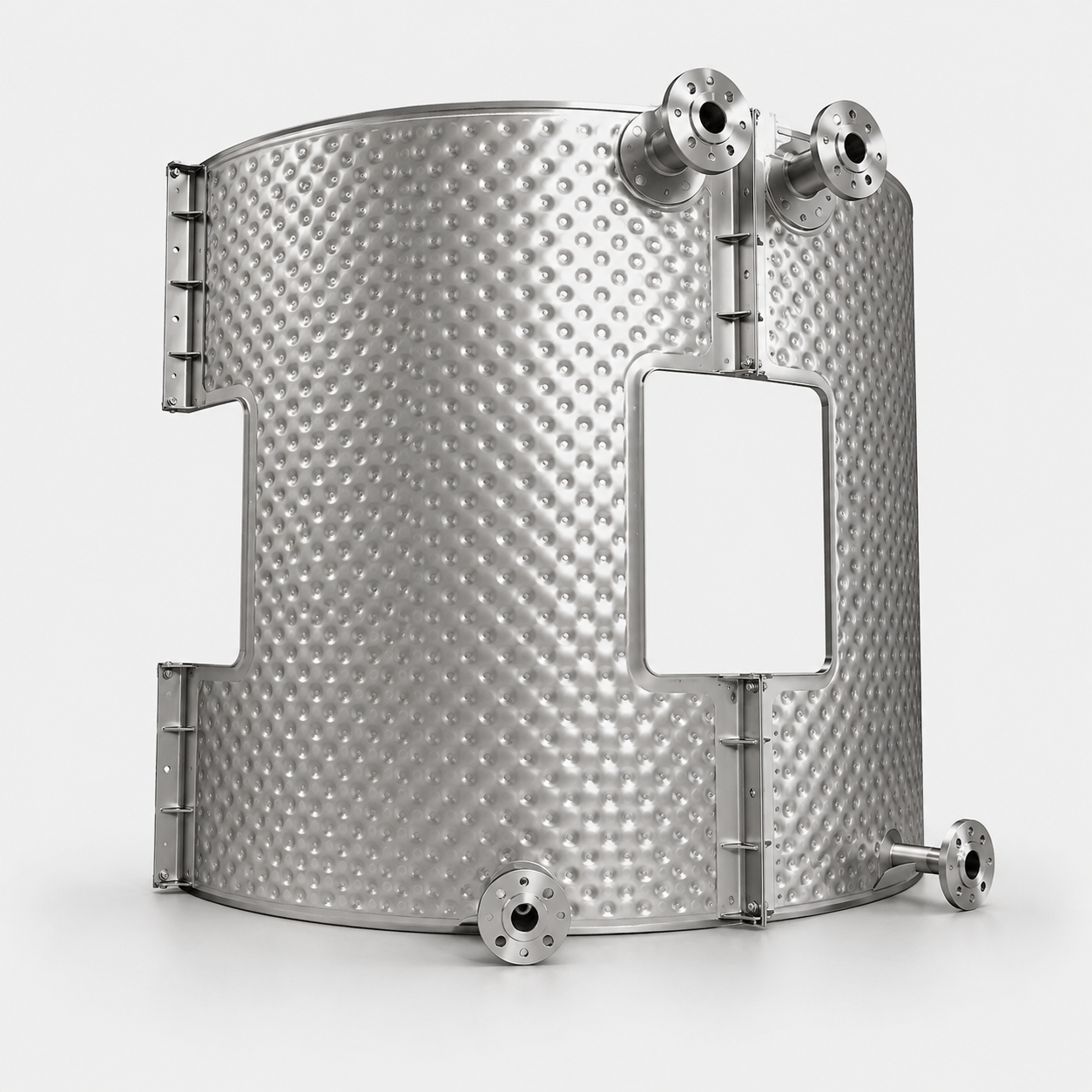
Clamp-On Assembly
If a tank you already own needs heating or cooling it does not have, the usual answer is expensive: replace...
+ Learn More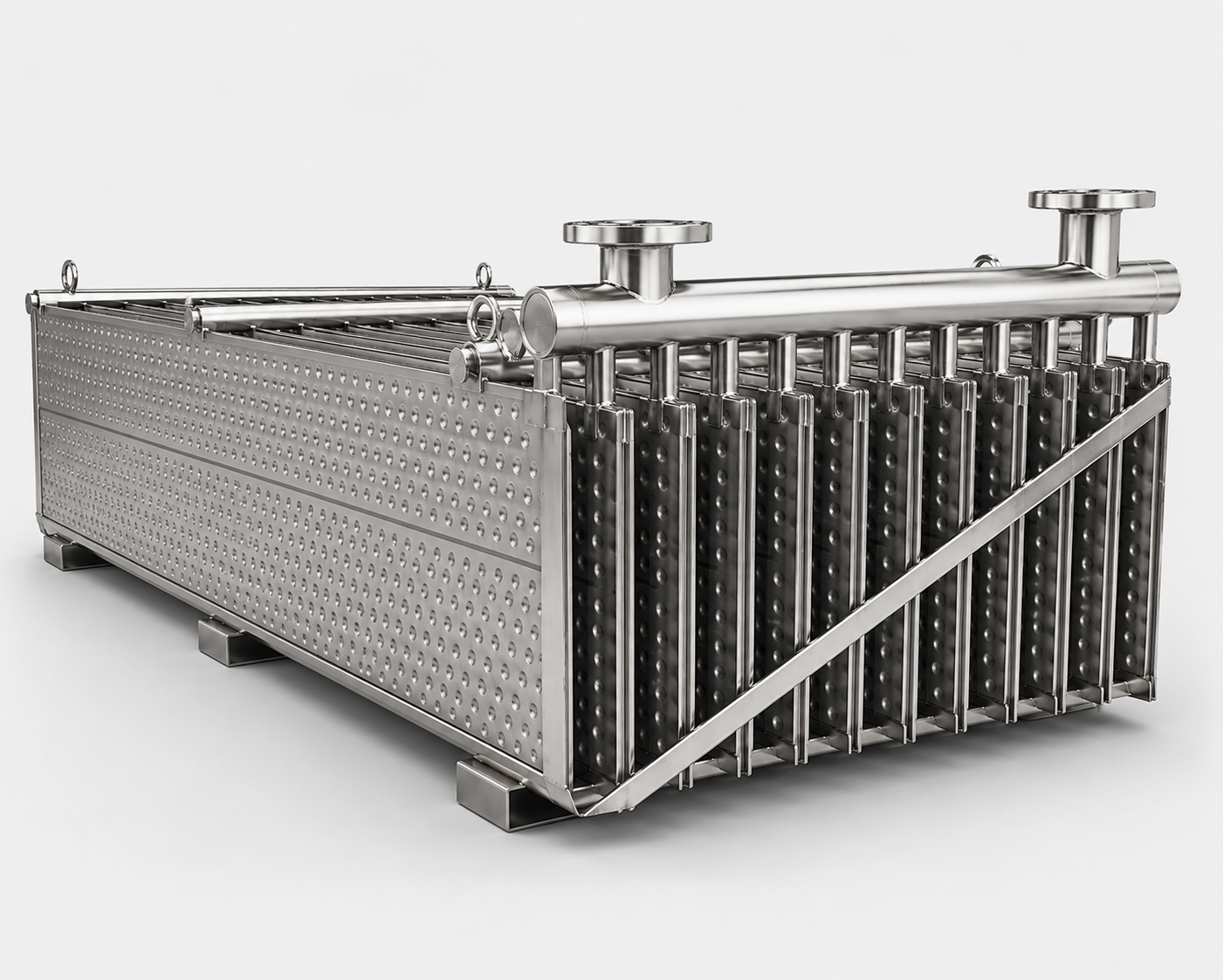
Bank Assembly
A bank is a set of inflated plates hung in parallel with product flowing between them. It gives you very fast...
+ Learn More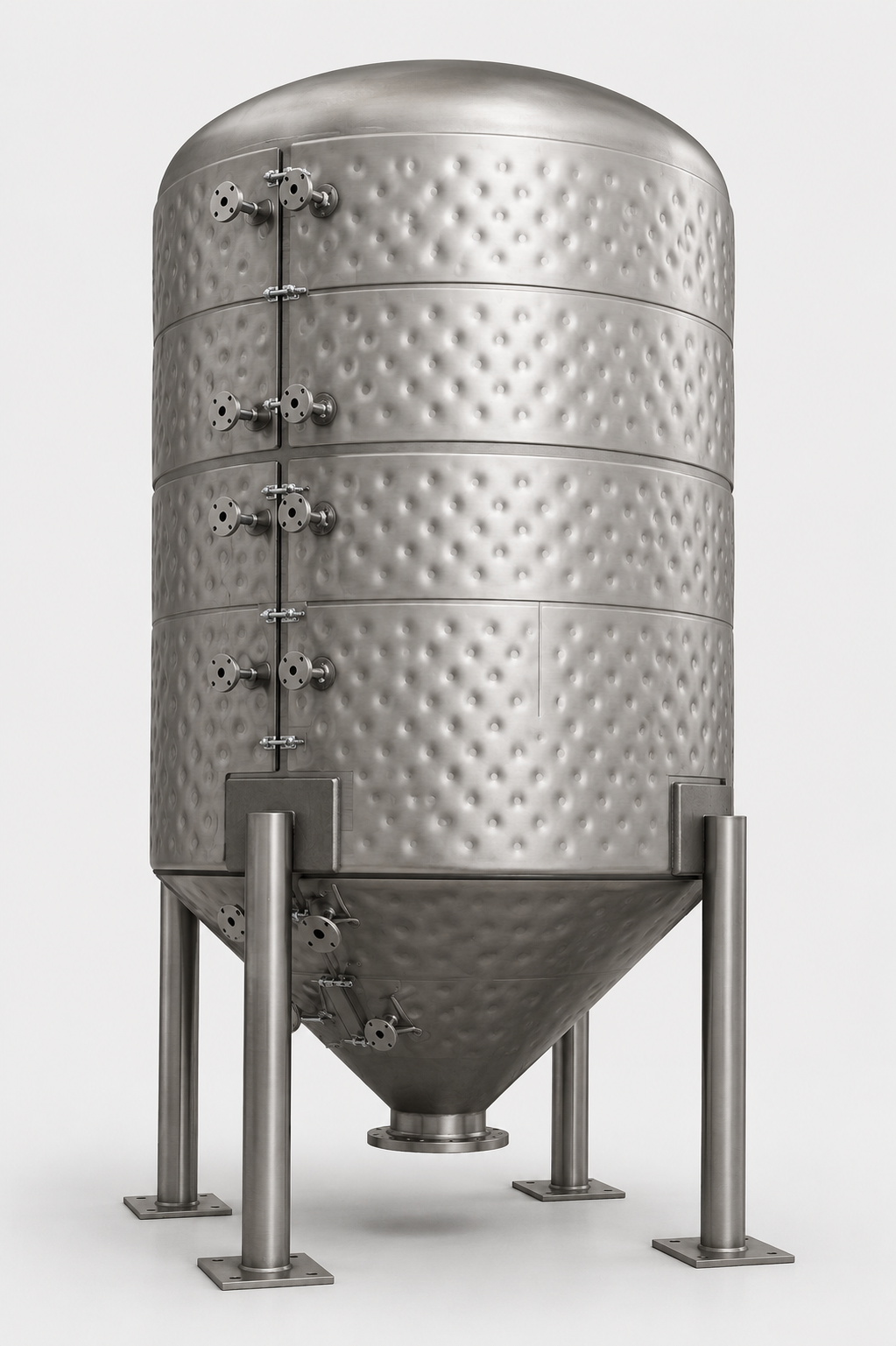
Integral Heat Transfer
Instead of bolting a heat exchanger to your equipment, build the heat transfer into the equipment. That is...
+ Learn More