
1-805-484-2992
Quotes - Engineering - SalesPower Generation
Auxiliary Cooling and Heat Recovery
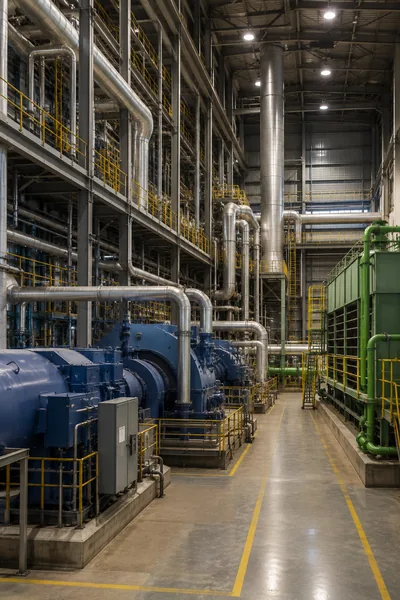
Power plants run auxiliary cooling circuits that nobody notices until one of them stops, and most of them are plate exchanger duty.
Power generation duty covers auxiliary cooling circuit isolation, condenser water isolation, lubrication oil cooling, diesel engine cooling and heat recovery, and co-generation and geothermal applications.
Isolation is the theme. Keeping open circulating water away from equipment that would foul or corrode is what most of these exchangers do, and the approach temperature they achieve determines how much cooling capacity survives the isolation.
Lube oil. Viscous, hot and critical. The plate corrugation generates turbulence at velocities where a tube would be laminar, which gives a much smaller exchanger for the same duty.
Co-generation and heat recovery. Recovering jacket water and exhaust heat into district or process heating is where plate exchangers earn their keep, because close approach converts directly into recovered energy.
Typical Specification
- Typical duty: Auxiliary cooling, condenser water isolation, lube oil
- Engine duty: Diesel jacket water cooling and heat recovery
- Co-generation: Jacket and exhaust heat into process or district heating
- Geothermal: Loop isolation and heat transfer
- Materials: Selected against circulating water chemistry
- Oil duty: Plate turbulence at low velocity
- Isolation benefit: Protects downstream equipment from open water
- Approach: Close approach preserves cooling capacity
- Redundancy: Spare plate sets recommended on critical circuits
- Cleaning: Frame opens for periodic service
Auxiliary cooling that keeps the plant on line
- Close approach on the isolation unit
- Spare plate set kept on site
- Lube oil checked at cold start
Questions on the duty
Every degree the isolation exchanger consumes arrives as a warmer supply at every auxiliary cooler downstream. In summer that can push bearing, generator air and oil coolers close to their limits. A tight approach on the isolation unit is often cheaper than upsizing the auxiliary coolers or accepting derates on hot days.
On circuits that would trip the plant if lost, a second full-size exchanger lets one be cleaned while the other runs. Where a single unit is accepted, a spare plate set kept on site turns a long wait for parts into a shift of work. The choice usually follows how often the circulating water fouls and how long the plant can run on reduced cooling.
Oil pressure should normally sit above the water side, so any leak sends oil out rather than water into the lube system. Viscosity rises sharply at cold start, and the plate selection should be checked at that condition as well as at running temperature. Ask for a double-wall or vented design if your plant standards call for a positive barrier between oil and water.
Jacket water usually runs warm enough that the gasket compound, not the plate, sets the limit. Glycol-treated coolant and engine coolant additives also have to be compatible with the elastomer. Send the maximum jacket temperature, coolant type and the pressure the engine system runs at, and the gasket is chosen to match.
Exhaust gas passes through a gas-to-water recovery unit first, and the plate exchanger sits in the water loop that carries that heat to the user. It separates the engine circuit from the district or process loop, so a leak or contamination stays on its own side. Close approach here raises the temperature the user receives.
Chlorides, silica, hydrogen sulfide, dissolved solids and pH at operating temperature, plus any non-condensable gas content. Geothermal brines can drop silica scale as they cool, so the cold end outlet temperature needs care. Plate material usually moves to titanium or a higher alloy, and the frame should open readily for descaling.
Related
Chemical Processing
Chemical plants ask more of alloy selection than anyone else, and they ask it about the film at the surface...
+ Learn More
Metal Finishing & Plating
Plating and finishing lines are full of hot aggressive tanks that need temperature control and nothing in...
+ Learn More
Pulp & Paper
Paper mills run some of the dirtiest and most alkaline streams in industry, and most of them carry heat worth...
+ Learn More