
1-805-484-2992
Quotes - Engineering - SalesFree-Flow Plate Heat Exchangers
Wide Channel Plates for Difficult Streams
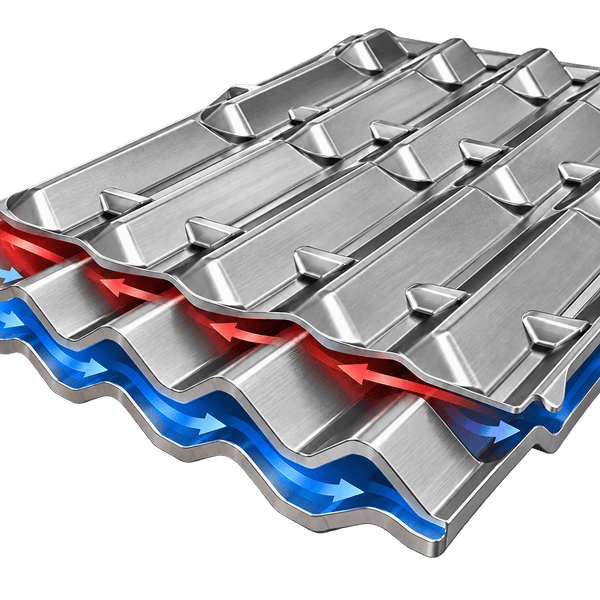
Conventional plates block on fibers and particulates. The Free-Flow plate opens the channel up, which lets it carry the streams that stop an ordinary plate pack dead.
The Free-Flow plate uses a corrugation designed with a far more open fluid path. It gives up some thermal efficiency per square foot and gains the ability to pass material that would bridge across a conventional plate and block the channel.
What it handles. Viscous products, slurries, effluent streams, pulps, and anything carrying fibers or particles up to roughly 3/8 inch. Fruit purees with pulp, mash, stillage, waste streams and paper mill liquors are the typical candidates.
Contamination still controlled. Each medium remains individually gasketed with the interspace vented to atmosphere, so the Free-Flow keeps the same no-cross-contamination behavior as the standard unit. That matters on food duty where the fluid being handled is exactly the kind that fouls.
Cleaning. The unit is expandable and lightweight, and it disassembles and cleans quickly. On streams that foul heavily, the value of a pack that opens in an hour rather than an afternoon compounds over a season.
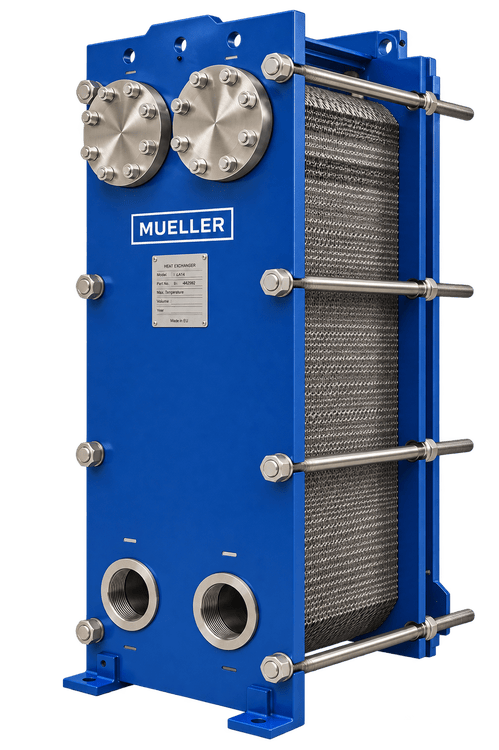
Part numbers. Every cataloged model, with the dimensions and ratings that separate them: Accu-Therm Free-Flow Part Numbers (16 part numbers).
Common to the Whole Series
Configuration
- Channel Gap: Wide gap, constant channel width (dimension not published)
- Connection Type: Studded port; sanitary S-line or Q-line ferrule
- Passes: Single pass standard
- Plate Pattern: Free-Flow (FF) - no contact points
- Plate Thickness: 0.6 mm (est.)
- Wall Construction: Single wall gasketed, free-flow
Materials
- Frame: Painted carbon steel as standard, stainless as an option, zinc-plated bolts
- Gasket: NBR or EPDM standard, or high-temp EPDM, Viton/FKM and butyl; FDA/3-A
- Gasket Attachment: Glue-In
- Plate: 316L SS standard; 304 SS, titanium, coated plates optional
Ratings
- Max Temperature: 302°F - 329°F, gasket dependent
- Min Temperature: 32°F MDMT
- Test Pressure: 1.3 x MAWP
Typical Specification
- Plate design: Open flow channel corrugation
- Particle size: Up to approximately 3/8 inch
- Typical fluids: Slurries, pulps, fibrous and viscous streams, effluent
- Gasketing: Each medium individually gasketed, interspace vented
- Materials: 304 and 316 stainless; higher alloys available
- Thermal efficiency: Lower per square foot than standard plates
- Pressure drop: Lower for a given flow than standard plates
- Cleaning: Rapid disassembly; expandable pack
- Duty: Waste heat recovery, product cooling, effluent interchange
- Alternative: Temp-Plate bank assembly for the heaviest solids
| PRODUCT | CONSTRUCTION | MATERIALS | SUPPLY |
| Free-Flow Plate Heat Exchangers | Mueller factory built | 304 / 316 stainless | New equipment |
Free-Flow Plate Heat Exchangers
The Trade You Are Making
A Free-Flow pack needs more surface area than a standard pack for the same duty, because opening the channel reduces turbulence. That is the price of not blocking, and on a stream that genuinely carries solids it is a price worth paying every time.
Where the solids loading is heavier still, or the stream is truly abrasive, a Temp-Plate bank assembly with removable plates is usually the better answer and we will say so.
Effluent and Energy Recovery
The most rewarding Free-Flow application is often recovering heat from a waste stream you were previously throwing away, precisely because that stream is dirty enough that nobody wanted to put an exchanger in it.
Interchanging warm effluent against incoming cold make-up water is frequently the shortest-payback heat recovery project in a food or paper plant.
Accu-Therm Free-Flow Part Numbers
Plate & Frame Part Numbers
A free-flow plate has no contact points across the channel. The herringbone pattern that gives a standard plate its turbulence is also what bridges when a stream carries fiber, and a free-flow plate trades some of that turbulence for a channel that passes solids.
What it is for. Stillage, mash, pulp, fruit purees, wastewater with suspended solids, anything where a standard pack would block rather than foul. If your stream is clean, this is the wrong plate — the standard pattern transfers more heat in less area.
The AT161FF is carried as a legacy designation: it appears in the Accu-Therm I&O manual and on installed nameplates but not in current literature.
Accu-Therm Free-Flow Part Numbers
Sizing for the Solids, Not the Clean Case
The gap has to pass the largest particle in the stream with margin, and that is a specification input rather than something we can infer. Tell us what is in the stream and roughly how much of it.
Fouling behavior follows from that. A free-flow unit still fouls; the difference is that it fouls in a way you can clean, because the pack opens and the channel is reachable.
Expect a Bigger Unit
Lower turbulence means a lower transfer coefficient, which means more surface for the same duty. A free-flow selection is physically larger than the standard-plate selection it replaces, and it should be — a smaller unit that blocks in a fortnight is not the cheaper answer.
Part Numbers
| Part Number | Frame | Plate H | Plate W | Port | Surface Area | Max Flow | Also Written |
|---|---|---|---|---|---|---|---|
| AT40FF | B or F frame | 70-1/4" | 27" | 4" | 99 - 2,292 sq ft | 800 | AT 40FF, AT-40FF, AT40 FF, AT40-FF |
| AT40FFB-10 | B-10 | B Frame, B-10 series | 70-1/4" | 27" | 4" | 99 - 2,292 sq ft | 800 | AT 40FFB-10, AT-40FFB-10 |
| AT40FFB-20 | B-20 | B Frame, B-20 series | 70-1/4" | 27" | 4" | 99 - 2,292 sq ft | 800 | AT 40FFB-20, AT-40FFB-20 |
| AT40FFF-20 | F-20 | F Frame, F-20 series | 70-1/4" | 27" | 4" | 99 - 2,292 sq ft | 800 | AT 40FFF-20, AT-40FFF-20 |
| AT161FF | B or F frame | 70-3/4" | 29" | 3" / 4" | 57 - 1,579 sq ft | 650 | AT 161FF, AT-161FF, AT161 FF, AT161-FF |
| AT161FFB-10 | B-10 | B Frame, B-10 series | 70-3/4" | 29" | 3" / 4" | 57 - 1,579 sq ft | 650 | AT 161FFB-10, AT-161FFB-10 |
| AT161FFB-20 | B-20 | B Frame, B-20 series | 70-3/4" | 29" | 3" / 4" | 57 - 1,579 sq ft | 650 | AT 161FFB-20, AT-161FFB-20 |
| AT161FFF-20 | F-20 | F Frame, F-20 series | 70-3/4" | 29" | 3" / 4" | 57 - 1,579 sq ft | 650 | AT 161FFF-20, AT-161FFF-20 |
| AT184FF | B or F frame | 91" | 36" | 8" | 165 - 2,734 sq ft | 3000 | AT 184FF, AT-184FF, AT184 FF, AT184-FF |
| AT184FFB-10 | B-10 | B Frame, B-10 series | 91" | 36" | 8" | 165 - 2,734 sq ft | 3000 | AT 184FFB-10, AT-184FFB-10 |
| AT184FFB-20 | B-20 | B Frame, B-20 series | 91" | 36" | 8" | 165 - 2,734 sq ft | 3000 | AT 184FFB-20, AT-184FFB-20 |
| AT184FFF-20 | F-20 | F Frame, F-20 series | 91" | 36" | 8" | 165 - 2,734 sq ft | 3000 | AT 184FFF-20, AT-184FFF-20 |
| AT192FF | B or F frame | 111-3/4" | 51-5/16" | 12" | 250 - 5,400 sq ft | 7100 | AT 192FF, AT-192FF, AT192 FF, AT192-FF |
| AT192FFB-10 | B-10 | B Frame, B-10 series | 111-3/4" | 51-5/16" | 12" | 250 - 5,400 sq ft | 7100 | AT 192FFB-10, AT-192FFB-10 |
| AT192FFB-20 | B-20 | B Frame, B-20 series | 111-3/4" | 51-5/16" | 12" | 250 - 5,400 sq ft | 7100 | AT 192FFB-20, AT-192FFB-20 |
| AT192FFF-20 | F-20 | F Frame, F-20 series | 111-3/4" | 51-5/16" | 12" | 250 - 5,400 sq ft | 7100 | AT 192FFF-20, AT-192FFF-20 |
16 part numbers. Figures marked (est.) are engineering estimates rather than Mueller published values — ask us to confirm before designing to one. Everything else traces to the source named in the catalog record.
Questions on the Free-Flow
Thick products run laminar in a wide channel, so the heat transfer coefficient falls and the required surface climbs quickly as viscosity rises. Viscosity also moves with temperature, and a product that pours freely hot can thicken sharply as it cools through the pack. Give us viscosity at both the inlet and outlet temperatures, or a lab curve, so the rating reflects what really happens at the cold end.
Routine soil comes off with CIP, and a channel with no contact points leaves fewer dead spots for residue than a herringbone plate does. Heavy fiber mats or baked-on solids clear fastest with the frame open. Because the channel is wide, the CIP supply needs more flow to reach a scouring velocity than a standard pack would, so check the CIP skid capacity at selection.
It is a legacy designation, kept in the table because installed units still carry it and their owners still need parts and replacements. If you are replacing an AT161FF, send the nameplate and the present duty and we will match it with a current selection or confirm parts for the existing frame. For a new project, select from the current range instead of designing around the older model.
This series uses glue-in gaskets, so every regasket includes stripping old cement and curing fresh adhesive. On a heavily fouling stream that is opened often, that labor adds up accross a season. Plants in that position often keep a second plate set, so one set can be regasketed in the shop while the other is running.
Related
Accu-Therm Plate Exchangers
The original Accu-Therm, and the unit most of this line is built from. It handles simple fluids, viscous...
+ Learn More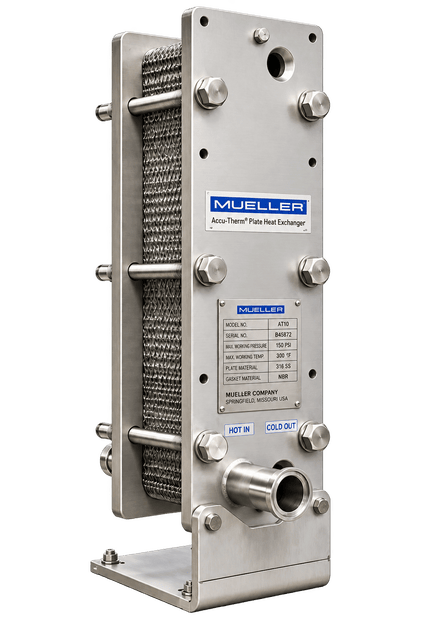
Sanitary Plate Exchangers
Sanitary duty asks two things at once: hit the thermal number, and prove afterward that the equipment can be...
+ Learn More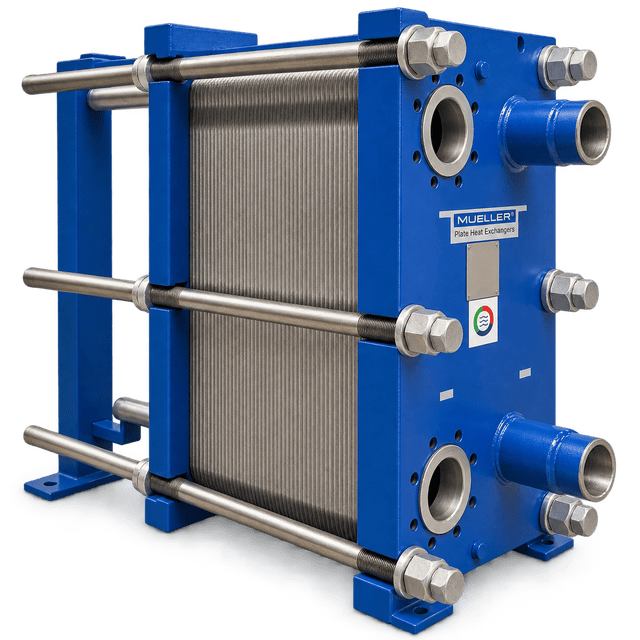
Semi-Welded Plate
Some fluids attack gaskets. Welding pairs of plates into cassettes puts those fluids inside a welded boundary...
+ Learn More