
1-805-484-2992
Quotes - Engineering - SalesSemi-Welded Plate Heat Exchangers
Welded One Side, Gasketed the Other
Some fluids attack gaskets. Welding pairs of plates into cassettes puts those fluids inside a welded boundary while leaving the other side gasketed, so you keep the serviceability where it matters.
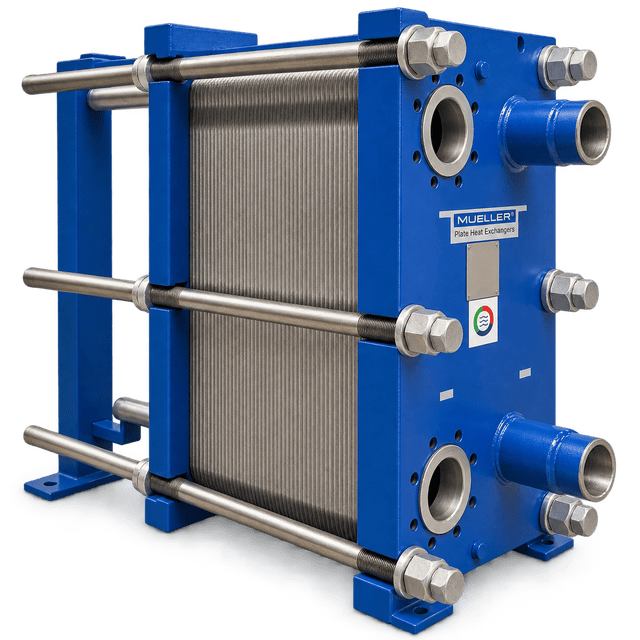
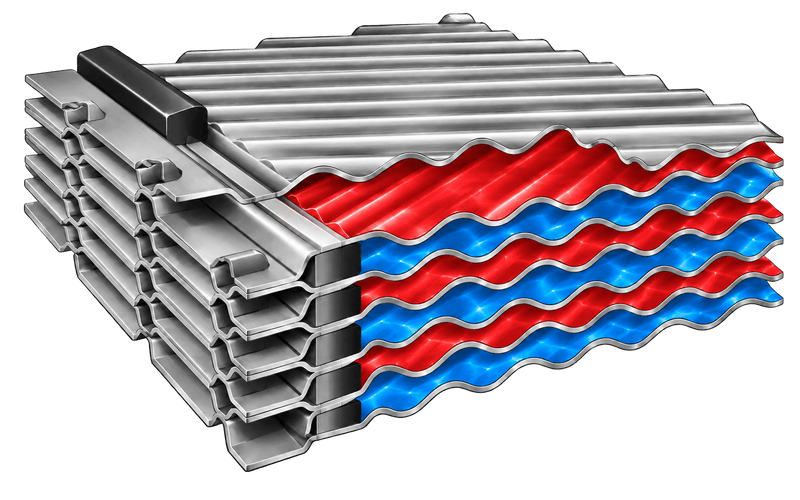
A semi-welded pack is built from cassettes: two plates laser welded together around the port and perimeter. The refrigerant or aggressive fluid travels inside the welded cassette. The water or glycol side stays conventionally gasketed between cassettes.
Where it is used. Solution chilling and refrigerant condensing in industrial refrigeration, principally ammonia. Ammonia attacks most elastomers, so a fully gasketed unit is not a reasonable proposition, and a fully welded unit gives up the service access on the water side where fouling actually happens.
What it buys you. The gasketed side still opens for cleaning and inspection, which is exactly the side that fouls on cooling tower or process water. The welded side needs no gasket maintenance at all.
What to watch. The welded cassette cannot be opened, so the refrigerant side has to be kept clean by system design rather than by service. Filtration and oil management on the refrigeration side matter more here than on a conventional unit.
Part numbers. Every cataloged model, with the dimensions and ratings that separate them: Accu-Therm Semi-Welded Part Numbers (14 part numbers).
Common to the Whole Series
Configuration
- Connection Type: Studded port, slip-on or weld-neck flange, ferrule. Rubber, steel, stainless, or Ti lined
- Passes: Single pass standard
- Plate Thickness: 0.6 mm
- Wall Construction: Semi-welded - welded cassette / gasketed secondary
Materials
- Frame: Carbon steel, blue painted; stainless steel optional
- Gasket: NBR, EPDM, Viton/FKM, Neoprene, or Chloroprene
- Gasket Attachment: Glue-In
Ratings
- Max Temperature: 300°F (est., gasket dependent)
- Max Working Pressure: 300 PSIG (150 - 300 PSIG design range)
- Min Temperature: -20°F (est.)
- Test Pressure: 1.3 x MAWP
Typical Specification
- Construction: Laser welded plate cassettes, gasketed between cassettes
- Welded side: Refrigerant or gasket-aggressive fluid
- Gasketed side: Water, glycol or process fluid; opens for service
- Typical refrigerants: Ammonia and halocarbon systems
- Duty: Solution chilling, refrigerant condensing, evaporating
- Plate materials: 316 stainless standard
- Gaskets: Compound selected for the gasketed side only
- Connections: Studded port, slip-on or weld neck flange, ferrule, stub end
- Service: Gasketed side inspectable; welded side sealed
- Expansion: Cassettes added within the frame
| PRODUCT | CONSTRUCTION | MATERIALS | SUPPLY |
| Semi-Welded Plate Heat Exchangers | Mueller factory built | 304 / 316 stainless | New equipment |
Semi-Welded Plate Heat Exchangers
Why Not a Fully Welded Unit?
A fully welded plate exchanger removes gaskets entirely, and it removes your access with them. On refrigeration duty the fouling almost always occurs on the water side, so a fully welded design seals up exactly the surface you most need to reach.
Semi-welded is the deliberate middle ground. It solves the gasket compatibility problem on the refrigerant side without giving up the maintenance advantage on the water side.
Ammonia Considerations
Ammonia systems bring their own requirements: material compatibility, relief arrangements, and careful attention to oil return. The exchanger is one component in that system and it needs to be specified alongside the rest of it rather than in isolation.
Tell us the refrigerant, the operating suction and discharge conditions and the secondary fluid, and the selection follows from there.
Accu-Therm Semi-Welded Part Numbers
Plate & Frame Part Numbers
A semi-welded pack is built from plate pairs laser welded around the refrigerant side, so no gasket ever sees the refrigerant. The gaskets are still there — they seal the water side, and the pack still opens for inspection — but the fluid that would attack them is on the welded side.
The W is the whole point. AT-9W, AT-15W, AT-25W and the rest carry the W for welded. The -TI variants are the same construction in titanium, for duty where the water side is aggressive as well.
This is the standard answer for ammonia, and for any refrigerant where a gasketed pack would be a maintenance problem rather than a selection.
Accu-Therm Semi-Welded Part Numbers
Where Semi-Welded Earns Its Cost
It costs more than a fully gasketed pack and it is worth it exactly where the refrigerant would otherwise be sealed by an elastomer. Ammonia is the clearest case. Any halocarbon that attacks the gasket compound is the next.
Where both sides are water or glycol, a standard gasketed pack is the right answer and this range is over-specified for the job.
Titanium, and When It Is Actually Needed
The -TI variants exist for chlorides — seawater, brackish water, some process streams, and cooling water treated in a way that concentrates chloride at the plate surface. Stainless plates crack in that service and titanium does not.
Titanium is not a general upgrade. If the water side is clean and the chloride level is known and low, stainless is the correct material and titanium is money spent on a problem you do not have. Send a water analysis and we will say which.
Part Numbers
| Part Number | Frame | Plate H | Plate W | Port | Surface Area | Max Flow | Also Written |
|---|---|---|---|---|---|---|---|
| AT-9W | Bolted frame, carbon steel with blue paint; stainless frame optional | 34.9" | 13.2" | 1-1/2" | — | 120 | AT 9W, AT9W |
| AT-9W-TI | Bolted frame, carbon steel with blue paint; stainless frame optional | 34.9" | 13.2" | 1-1/2" | — | 120 | AT 9W-TI, AT9W-TI |
| AT-15W | Bolted frame, carbon steel with blue paint; stainless frame optional | 45.2" | 13.2" | 1-1/2" | — | 120 | AT 15W, AT15W |
| AT-15W-TI | Bolted frame, carbon steel with blue paint; stainless frame optional | 45.2" | 13.2" | 1-1/2" | — | 120 | AT 15W-TI, AT15W-TI |
| AT-25W | Bolted frame, carbon steel with blue paint; stainless frame optional | 49.8" | 21.7" | 4" | — | 800 | AT 25W, AT25W |
| AT-25W-TI | Bolted frame, carbon steel with blue paint; stainless frame optional | 49.8" | 21.7" | 4" | — | 800 | AT 25W-TI, AT25W-TI |
| AT-40W | Bolted frame, carbon steel with blue paint; stainless frame optional | 67.4" | 18.7" | 3" | — | 450 | AT 40W, AT40W |
| AT-40W-TI | Bolted frame, carbon steel with blue paint; stainless frame optional | 67.4" | 18.7" | 3" | — | 450 | AT 40W-TI, AT40W-TI |
| AT-50W | Bolted frame, carbon steel with blue paint; stainless frame optional | 68.7" | 21.7" | 4" | — | 800 | AT 50W, AT50W |
| AT-50W-TI | Bolted frame, carbon steel with blue paint; stainless frame optional | 68.7" | 21.7" | 4" | — | 800 | AT 50W-TI, AT50W-TI |
| AT-65W | Bolted frame, carbon steel with blue paint; stainless frame optional | 68.9" | 28.7" | 8" | — | 3200 | AT 65W, AT65W |
| AT-65W-TI | Bolted frame, carbon steel with blue paint; stainless frame optional | 68.9" | 28.7" | 8" | — | 3200 | AT 65W-TI, AT65W-TI |
| AT-85W | Bolted frame, carbon steel with blue paint; stainless frame optional | 90.2" | 28.7" | 8" | — | 3200 | AT 85W, AT85W |
| AT-85W-TI | Bolted frame, carbon steel with blue paint; stainless frame optional | 90.2" | 28.7" | 8" | — | 3200 | AT 85W-TI, AT85W-TI |
14 part numbers. Figures marked (est.) are engineering estimates rather than Mueller published values — ask us to confirm before designing to one. Everything else traces to the source named in the catalog record.
Semi-Welded ordering questions
Compressor oil is heavier than liquid ammonia and does not mix with it, so in a flooded or thermosiphon circuit it settles at the low point of the refrigerant side. The cassettes cannot be opened, which makes a drain at that low point and a regular draining routine the only way to keep oil off the plates. Tell us the system type so the connections and drain arrangement suit it.
Choose it on the secondary fluid and its temperature. EPDM is the usual pick for water and glycol, while NBR suits a secondary that carries oil. The welded cassettes keep the refrigerant away from the field gaskets between them, so water chemistry and temperature drive the decision. Tell us the glycol type and concentration too, since inhibitor packages vary in what they do to elastomers.
The working pressure depends on the frame and plate chosen within that span, so not every model is rated at the top figure. On ammonia condensing, the discharge pressure and the relief valve setting set the requirement on the welded side. Give us the refrigerant relief setting and the pump shutoff head on the water side, and the selection will be checked against both.
Cassettes can be added within the frame much as plates are on a gasketed unit, provided the carrying bar and tie bolts leave room. On refrigeration duty the charge matters too, since extra cassettes add internal volume and change how much ammonia a flooded circuit holds. If a plant expansion is planned, mention it at the start so the frame length and the charge are both considered.
A cassette leaking at the weld cannot be repaired in place, so it is replaced whole, or removed as a stopgap with the pack tightened to the shorter dimension. Pulling cassettes lowers capacity, so check the duty margin before running that way for long. On a critical refrigeration system, holding a spare cassette shortens the outage considerably.
Both share a 13.2 inch plate width and a 1-1/2 inch port. The difference is plate height, 34.9 inches against 45.2. A taller plate gives a longer thermal path per pass, which helps reach a close approach, while the shorter plate keeps pressure drop down at the same flow. The thermal rating decides between them, so send the refrigerant conditions and secondary flows rather than choosing by size.
Related
Accu-Therm Plate Exchangers
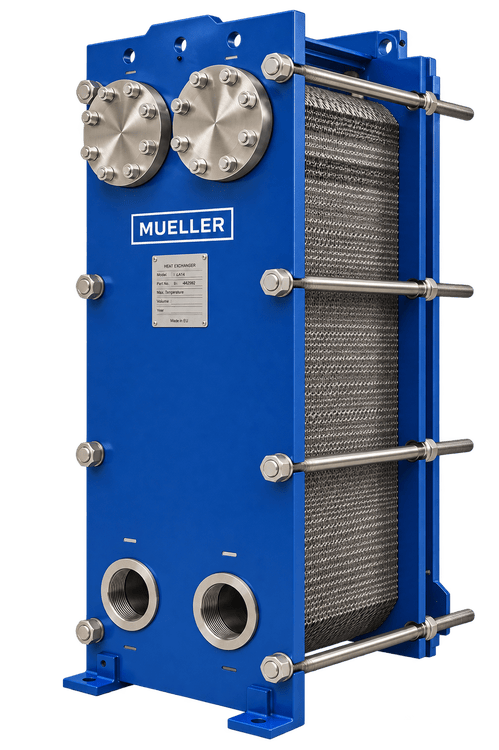
The original Accu-Therm, and the unit most of this line is built from. It handles simple fluids, viscous...
+ Learn More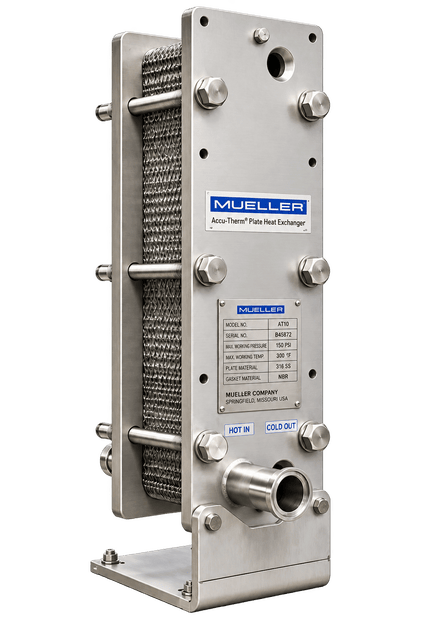
Sanitary Plate Exchangers
Sanitary duty asks two things at once: hit the thermal number, and prove afterward that the equipment can be...
+ Learn More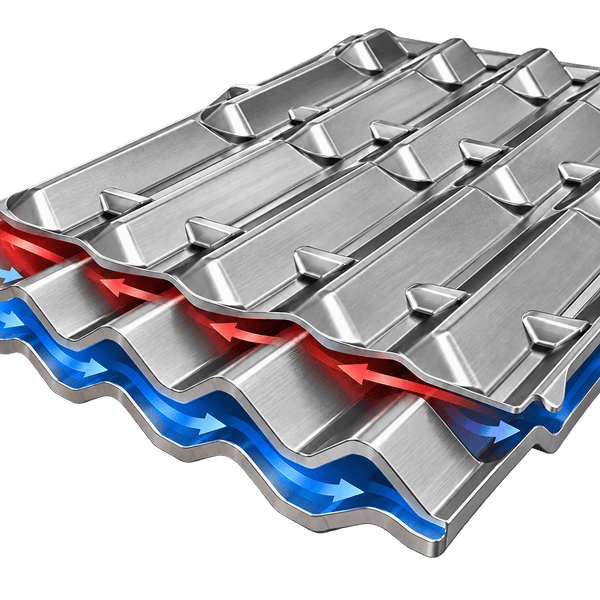
Free-Flow Plate
Conventional plates block on fibers and particulates. The Free-Flow plate opens the channel up, which lets it...
+ Learn More