
1-805-484-2992
Quotes - Engineering - SalesDistrict Energy
Building Interfaces and Network Separation
District systems live or die on the temperature difference they can maintain between supply and return, and every exchanger in the network consumes part of it.
District heating and cooling networks connect through energy transfer stations, where a plate exchanger separates the network from each building's internal loop.
Approach costs delta T. Every degree the exchanger consumes reduces the network's usable temperature difference, which reduces the capacity the same pipe can carry. On a district network that is a capital cost, not just an operating one.
Return temperature matters. Networks are penalized for high return temperatures, and a poorly selected building interface is a common cause. Getting the exchanger approach right protects the whole network.
Space and expansion. Building plant rooms are tight and loads grow. A frame with expansion room is far cheaper now than a replacement later.
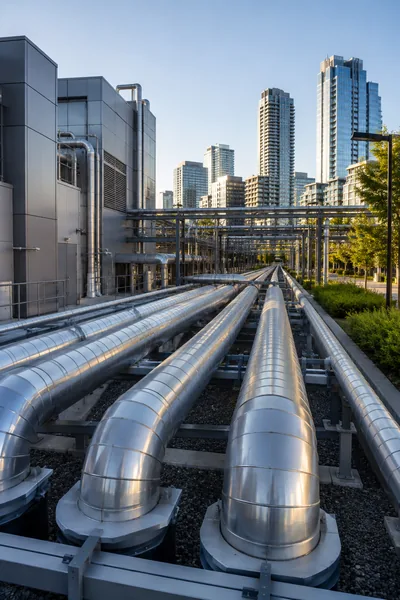
Typical Specification
- Application: Energy transfer stations, building interfaces
- Key metric: Approach temperature and return temperature
- Network effect: Approach consumes usable network delta T
- Footprint: Small plant room requirement
- Expansion: Plates added within the frame
- Materials: Stainless standard; selected against water chemistry
- Pressure: Frame rated for network static pressure
- Isolation: Protects building loop from network water
- Metering: Exchanger sized to suit metering arrangement
- Service: Frame opens for cleaning and inspection
What a building interface owes the district network
- Approach held tight to protect delta T
- Return temperature inside network limits
- Spare frame length for added plates
Process questions
Tighter than most building engineers expect, because the network operator usually sets the return temperature each building must hand back. Work backward from that return limit and the building's own supply requirement, and the approach becomes a fixed target rather than a choice. Send us the network supply and return values and the building loop temperatures, and we can show how many plates it takes to meet them.
Two units at roughly half to two-thirds capacity each are common where the building cannot tolerate an outage. One can be opened for cleaning while the other carries the load through a mild season. A single frame is cheaper and simpler, so the decision usually comes down to how the building copes with a day without heat or cooling.
The frame rating has to cover the network side, which in a tall building or on a hilly network can sit well above the building loop. Engineers sometimes pick the frame on building side pressure and only catch the mismatch at submittal review. Give us the highest static plus pump head the network side will see, and the frame and plate gauge are chosen from that.
An exchanger with far more surface than today's load needs runs at very low network flow, and control at that low end is poor. The valve hunts, the building swings between too warm and to cool, and return temperature creeps up. Buying the frame for the future load but hanging only today's plates in it avoids the problem while keeping the expansion route open.
Higher temperatures on the network side, which moves gasket compound and frame rating up the list. Heating networks often lower their supply temperature in mild weather, so the exchanger should be checked at that reduced supply as well as at the design point. Cooling interfaces work on a much narrower temperature difference, which makes approach the dominant number there.
Related
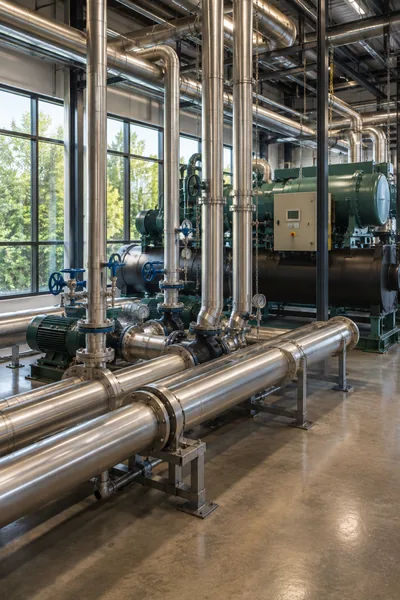
Water-Side Economizer
When the wet bulb is low enough the cooling tower can meet the load on its own and the chillers can stop. The...
+ Learn More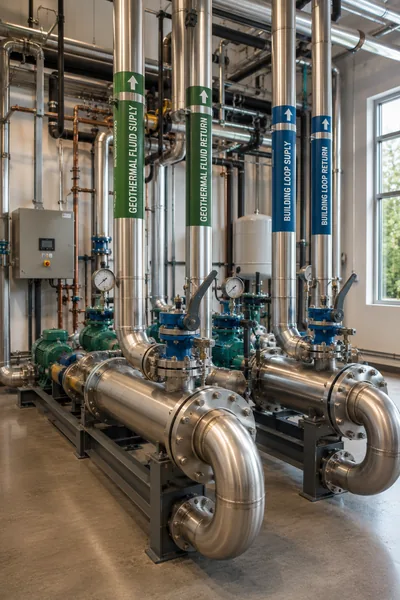
Geothermal & Heat Pump
Ground loops and heat pump systems live on small temperature differences, which makes the exchanger approach...
+ Learn More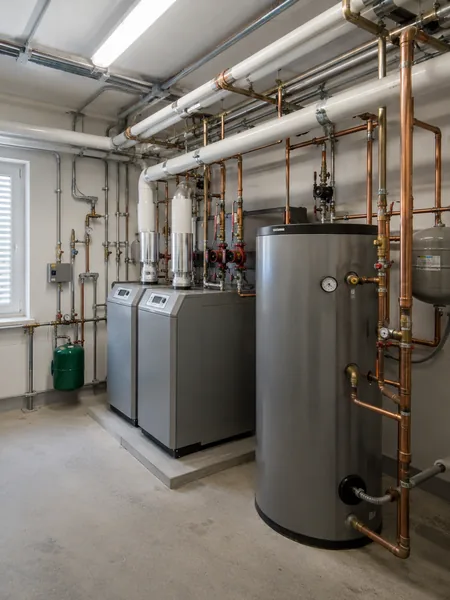
Domestic Water Heating
Heating potable water with a non-potable fluid raises a question no thermal calculation answers: what happens...
+ Learn More