
1-805-484-2992
Quotes - Engineering - SalesHot Water & Glycol Heating
Closed Loop Liquid Heating
Closed loop, liquid to liquid, modest temperature difference. The design is undemanding until glycol enters it, at which point viscosity changes both the heat transfer and the pumping.
Hot water and glycol loops isolate a process from a primary heat source, carry freeze protection into equipment exposed to ambient, and distribute heat around a plant from one central source.
Glycol is not water with antifreeze in it. It is more viscous, less conductive and has lower specific heat. All three work against you at once, and a loop converted from water to glycol without resizing will fall short of duty by more than most people expect.
Size for the cold start. Glycol viscosity rises steeply as temperature falls. A loop comfortably turbulent at operating temperature can be laminar on a cold morning, and once flow goes laminar the coefficient collapses.
Concentration costs performance. Every point of glycol above what the freeze protection needs costs heat transfer and pumping power. Set it to the protection temperature you actually require and monitor it, because it drifts with make-up.
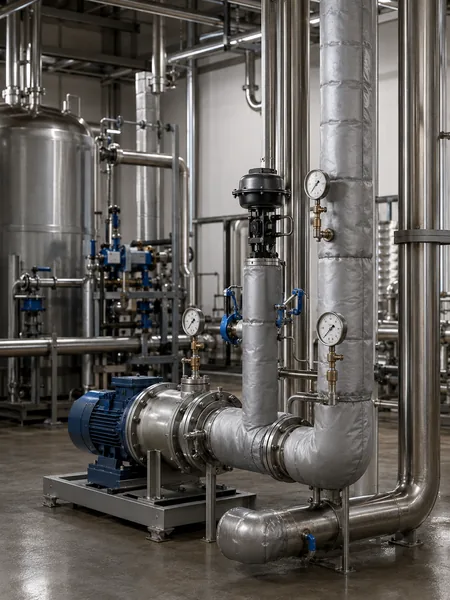
A closed liquid circuit carrying hot water or a glycol solution from a central heat source to process users, where glycol adds freeze protection at the cost of viscosity, conductivity and specific heat.
Selection notes
Tell us the concentration actually in the loop, measured with a refractometer, plus the freeze point you need to protect against. Loops often run richer than required because someone topped up with straight glycol, and that extra concentration costs heat transfer. If the two differ we can size against either, and we will point out what the correction is worth.
Give us the lowest loop temperture at startup alongside the normal operating point. We check the flow regime at that cold condition, and if the channels go laminar we adjust plate pattern or pass arrangement so the coefficient holds. A unit checked only at operating temperature can take hours to bring a cold glycol loop up.
On a small, clean, well-treated closed loop it often is, and it saves space and cost. It cannot be opened, so it suits loops where fouling is unlikely and replacement is easier than cleaning. On a large loop, or one with a poor treatment history, the gasketed frame is worth its higher first cost.
EPDM is the common choice for hot water and glycol, since it handles both well accross normal loop temperatures. Nitrile becomes the weaker option as temperatures rise. Check that the inhibitor package contains nothing the compound dislikes, and tell us the peak supply temperature, because that is what decides gasket life.
More than the water loop did, because glycol carries less heat per gallon for each degree of temperature change. To move the same load at the same temperature drop, flow has to rise, and pressure drop rises faster still because the fluid is thicker. Check the pump curve before converting a loop, since the exchanger is often not the only part left short.
Related
Steam-to-Water Heating
Steam on one side, water on the other, and a temperature difference large enough that the exchanger selection...
+ Learn More
Product & Ingredient Heating
Heating the product itself is a different problem from heating a utility. The stream is valuable, often...
+ Learn More
CIP Solution Heating
A CIP heater has to bring aggressive chemistry to setpoint quickly and then be cleaned itself. It is one of...
+ Learn More