
1-805-484-2992
Quotes - Engineering - SalesDomestic Water Heating
Potable Water and Instantaneous Heating
Heating potable water with a non-potable fluid raises a question no thermal calculation answers: what happens the day that barrier gives way.
Domestic hot water duty uses plate exchangers for instantaneous and semi-instantaneous heating from boiler water, district heat or recovered condenser heat.
Double-wall construction. Where a non-potable fluid heats potable water, double-wall plates put a vented gap in the leak path so a breach appears outside the unit. Many jurisdictions require it and it is worth confirming rather than assuming.
Instantaneous means control. Domestic hot water demand is spiky, and an exchanger sized on peak flow can be badly controlled at trickle flow. Control valve sizing and turndown belong in the same conversation as the exchanger.
Scaling. Hard water scales at the hot surface. Lowering the medium temperature and adding surface reduces scaling rate substantially, and a frame that opens makes descaling a routine job.
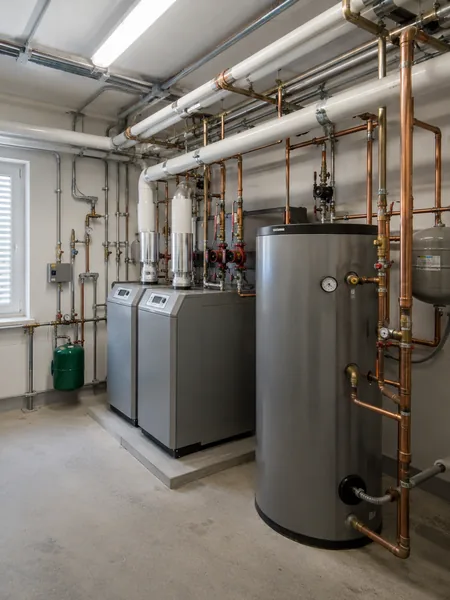
Typical Specification
- Application: Instantaneous and semi-instantaneous domestic hot water
- Construction: Double-wall plates where required for potable duty
- Heat source: Boiler water, district heat, recovered condenser heat
- Control: Turndown and valve sizing designed with the exchanger
- Scaling: Reduced by lower medium temperature and more surface
- Cleaning: Frame opens for descaling
- Materials: 316 stainless standard
- Regulatory: Confirm double-wall requirement with the authority
- Small duties: Brazed plate where a frame is not warranted
- Recovery: Condenser heat recovery as a pre-heat stage
Specifying a potable water heater without surprises
- Double-wall requirement confirmed in writing
- Control valve sized for trickle flow
- Hot side temperature kept moderate
Questions we hear often
A breach in either plate lets fluid into the vented gap, and it shows up as a drip or wet streak at the plate edge outside the pack. Nothing crosses into the potable side as long as that vent path stays clear. Maintenance staff should know what the weep looks like, because it is a signal to open the frame, not a gasket to tighten.
Some heat transfer, because two plates and the gap between them add resistance compared with a single plate. The exchanger needs extra surface to make the same duty at the same approach, so the pack carries more plates or the frame grows. Tell us at the start that the duty is double-wall so the selection is made that way, not converted from a single-wall design.
That depends on how sharp the peaks are and how much heat source capacity is available. A purely instantaneous system needs the boiler or district connection to deliver the full peak, while a semi-instantaneous design uses a small buffer to shave it. Hotels and dormitories with short morning surges often favor some storage, and we size the plate pack to whichever arrangement you choose.
Usually as a preheat stage ahead of the main heater, since condenser water is rarely hot enough to finish the job. Incoming cold water picks up rejected chiller heat first, and the boiler or district exchanger only covers the remaining rise. If the condenser loop is non-potable, the preheat exchanger needs double-wall plates just like the final heater.
For a modest load on soft or treated water it is compact and economical. The catch is that a brazed unit cannot be opened, so on hard water any scale has to come out by chemical flushing alone. Where the building water is hard and the unit sits on a hot source, a small gasketed frame usually earns back its higher first cost.
Related
District Energy
District systems live or die on the temperture difference they can maintain between supply and return, and...
+ Learn More
Water-Side Economizer
When the wet bulb is low enough the cooling tower can meet the load on its own and the chillers can stop. The...
+ Learn More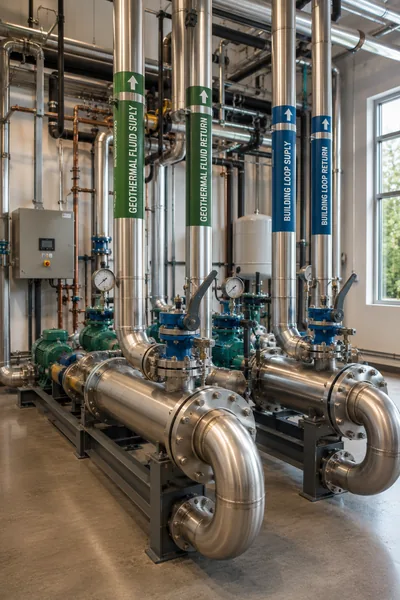
Geothermal & Heat Pump
Ground loops and heat pump systems live on small temperature differences, which makes the exchanger approach...
+ Learn More