
1-805-484-2992
Quotes - Engineering - SalesHEAT EXCHANGERS
Brazed Plate Heat Exchangers
Take a plate pack, remove the gaskets and the frame, and braze the whole thing into a single sealed block. What you lose is serviceability. What you gain is pressure capability, compactness and price.
A brazed plate exchanger is built from 316 stainless plates vacuum brazed together with copper or nickel filler. Unit size, plate count and connection type are varied to match the duty. Because there is no frame, no gasket and no compression hardware, the unit is dramatically smaller and cheaper than an equivalent gasketed exchanger, and it holds far more pressure.
Part numbers. Every cataloged model, with the dimensions and ratings that separate them: L-Line Brazed Plate Part Numbers (21 part numbers).





- No gaskets. Nothing to select, replace or get wrong. On clean duty in a sealed system, that removes the most common maintenance item on a plate exchanger.
- High pressure. The brazed block handles pressures well beyond what a gasketed frame will hold, which is why brazed plate dominates refrigerant duty.
- Very compact. No frame, no tie bolts and no clearance for opening the pack. A brazed unit occupies a fraction of the space.
- Large range. Mueller offers one of the widest brazed plate ranges available, with many sizes held in stock and shipping the next day in most cases.
- Copper or nickel brazed. Copper for the great majority of duty; nickel where ammonia or certain chemistries rule copper out.
- Sealed for life. It cannot be opened, cleaned mechanically or expanded. That is the trade, and it is the right trade on clean, stable duty.
Brazed Plate Heat Exchangers
When Brazed Is the Right Choice
Clean fluids in a closed system, moderate to high pressure, limited space and a duty that is not going to change. Refrigerant evaporators and condensers, hydraulic oil cooling, domestic hot water and small heat recovery duties all fit that description.
The decision is really about fouling. If the fluid deposits anything, a brazed unit will eventually foul and there is no way to open it. On genuinely clean duty that never happens and the unit outlasts everything around it.
When It Is Not
Anything that fouls, anything with particulates, anything where the duty may need to grow, and anything where an inspection of the heat transfer surface will be required.
Those are all arguments for a gasketed Accu-Therm, and we will make them. Buying a brazed unit for a fouling duty because it is cheaper on day one is a decision that reverses itself within a couple of years.
Related
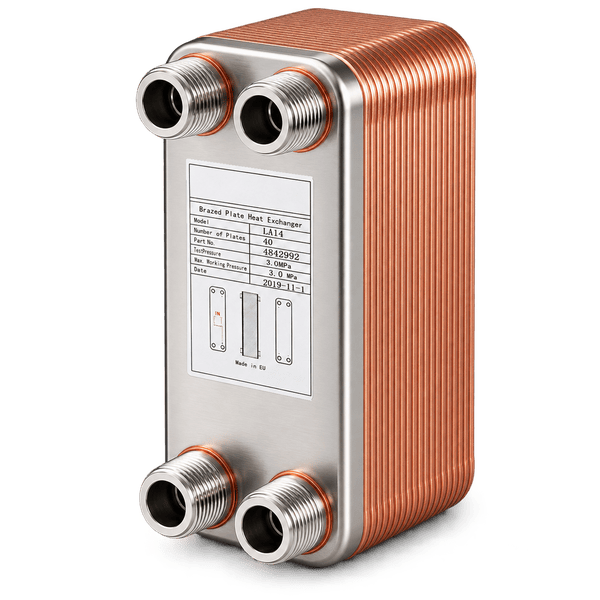
Copper Brazed Plate
Copper brazing is the default, and for the great majority of duties it is also the right answer. It is...
+ Learn More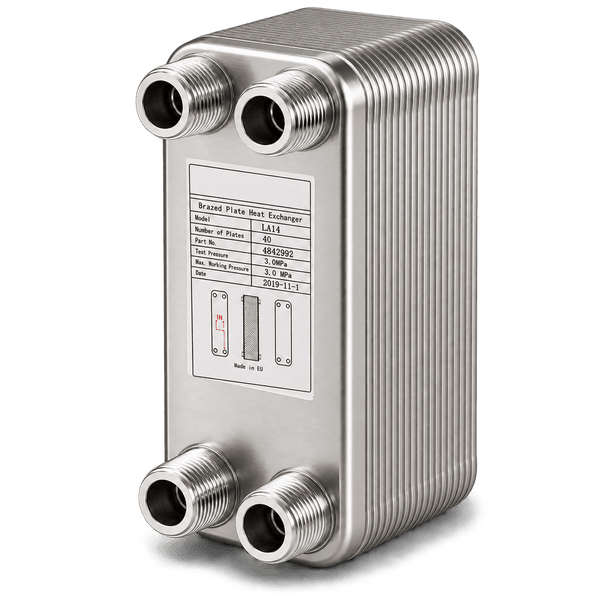
Nickel Brazed Plate
Nickel brazing exists for one main reason: ammonia destroys copper. Where the fluid rules out a copper brazed...
+ Learn More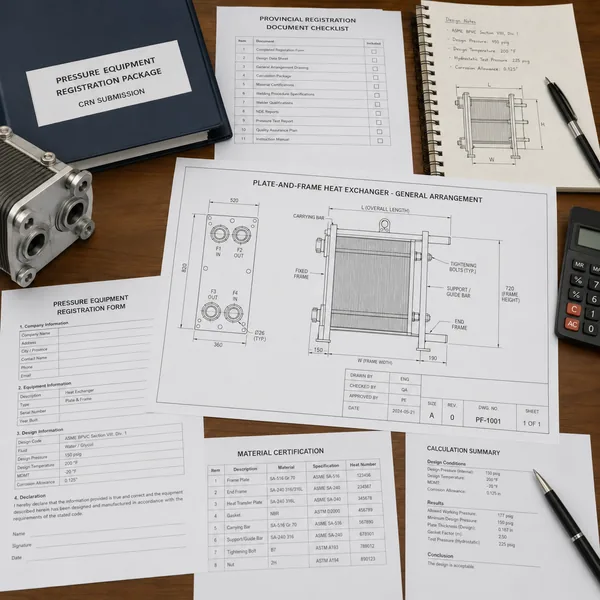
Sizing & Selection
Brazed plate units are cheap enough that people buy them from a table. That works until it does not, and when...
+ Learn MoreQuestions on the range
Only by pumping a cleaning solution through it, ideally in the reverse direction of normal flow so loose deposits leave by the way they came in. The chemistry has to suit both the scale and the braze metal, since acids that are fine on stainless can attack copper joints. Plan the isolation valves and flush connections at installation, because adding them later means draining the system.
Every point where two plates touch becomes a brazed joint, so the pack behaves like one welded block rather than a stack held shut by bolts. A gasketed frame is limited by how hard the gaskets can be squeezed before they blow out. That difference is why refrigerant circuits, with their high condensing pressures, so often end up on brazed plate.
Tower water picks up dust, biological growth and scale as it evaporates, and all of it settles in narrow brazed channels. With no way to open the pack, the unit slowly loses capacity until it can no longer hold the setpoint. Either isolate the brazed unit behind a gasketed exchanger on the tower side or keep the water treatment and strainer under strict control.
It is replaced as a complete unit. An internal leak between circuits can not be located or sealed, and the price of a new block is usually below the labor of trying. Many sizes are held in stock, so a failed unit on a production line can often be matched and shipped the next day.
Refrigerant duty combines high pressure, clean fluids and a need to keep the charge small, which suits a sealed block exactly. There are no gaskets for refrigerant to permeate, and the small internal volume holds less charge than a tube bundle. Copper braze suits halocarbons, while ammonia circuits move to nickel.