
1-805-484-2992
Quotes - Engineering - SalesBrazed Plate Sizing & Selection
Getting the Selection Right First Time
Brazed plate units are cheap enough that people buy them from a table. That works until it does not, and when it does not the unit cannot be opened to find out why.
Within a model family, capacity comes from plate count. More plates means more surface, more capacity and more pressure drop. The selection exercise is finding the plate count that meets the thermal duty inside the pressure drop you can afford, on both sides.
What we need. Both fluids identified, flow rates, inlet and required outlet temperatures, design pressure and the allowable pressure drop each side. On refrigerant duty, the refrigerant, the saturation conditions and whether the unit evaporates or condenses.
Fouling allowance. Because a brazed unit cannot be opened, fouling allowance matters more than on a gasketed unit. Being honest about water quality at selection is the difference between a unit that runs for a decade and one that blocks in two years.
Know when to walk away. If the fluid carries particulates, if the duty may grow, or if anyone will need to see the heat transfer surface, a brazed unit is the wrong purchase regardless of price. We will say so rather than sell one.
Typical Specification
- Capacity: Set by plate count within a model family
- Thermal inputs: Flow, inlet and outlet temperatures, both fluids
- Hydraulic inputs: Allowable pressure drop each side
- Mechanical inputs: Design pressure and temperature
- Refrigerant inputs: Refrigerant, saturation conditions, evaporating or condensing
- Fouling: Allowance matters more than on a gasketed unit
- Braze material: Copper standard, nickel for ammonia
- Connections: Threaded, soldered or flanged
- Not suitable: Particulates, growing duty, inspectable surface required
- Alternative: Gasketed Accu-Therm where any of those apply
| PRODUCT | CONSTRUCTION | MATERIALS | SUPPLY |
| Brazed Plate Sizing & Selection | Mueller factory built | 304 / 316 stainless | New equipment |
Request a QuoteSelect on allowable pressure drop as firmly as on thermal duty, because a brazed unit cannot be opened to correct a bad pick.
Brazed plate sizing: the rule
Brazed Plate Sizing & Selection
Pressure Drop Is the Usual Surprise
Brazed plate channels are narrow, and pressure drop rises quickly with flow. A unit selected on thermal duty alone can meet the temperature target and be impossible to pump through at the flow the system delivers.
Send the allowable pressure drop with the duty. It is the figure most inquiries leave out, and the one most likely to change which unit you end up with.
Questions engineers ask
The selection was made on heat load alone and the pressure drop came out higher than the pump curve can deliver. Flow falls back to where the curve meets the system, and the unit then misses its duty in service. Give us the allowable drop on each side, or the pump curve, and the plate count is chosen to stay inside it.
A modest margin backed by a strainer and good water treatment beats a generous one. Extra plates slow the velocity in each channel, and slow water drops its solids more readily, so a heavily oversized unit can foul faster than a correctly sized one. Tell us the water source and how it is treated and the allowance is set to match.
The inputs shift toward the condensing pressure and the subcooling you want leaving the unit. Hot gas enters well above saturation, so part of the plate desuperheats before condensing begins, and any subcooling needs its own share of surface. Report the discharge temperature as well as the condensing temperature, because leaving it out understates the load.
Either select the plate count for the future duty now, or plan for a second unit in paralell when the load arrives. Oversizing today means lower velocity until the growth happens, so it suits clean closed loops better than open water. Parallel units add valves and piping but let one be cleaned while the other runs.
The close approach depends on the two fluids running counterflow, and swapping one pair of connections turns the unit into a parallel flow exchanger. It still transfers heat, but the leaving temperatures cannot cross and the duty falls short. Check the port labels against the piping drawing before the unit is installed, since repiping afterward is costly.
Related
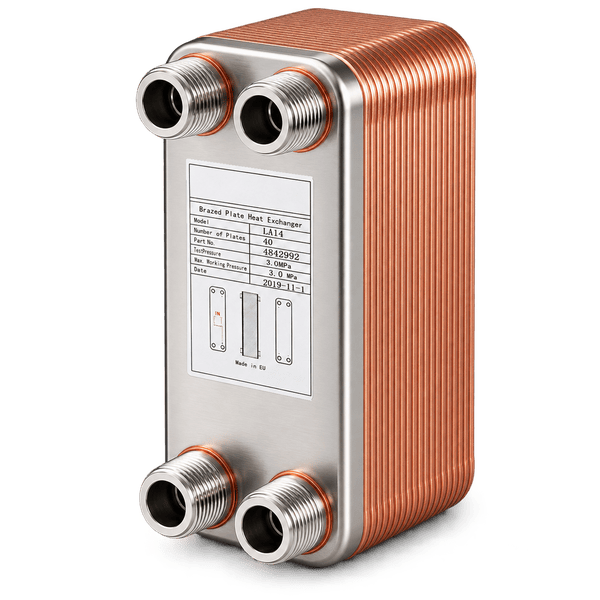
Copper Brazed Plate
Copper brazing is the default, and for the great majority of duties it is also the right answer. It is...
+ Learn More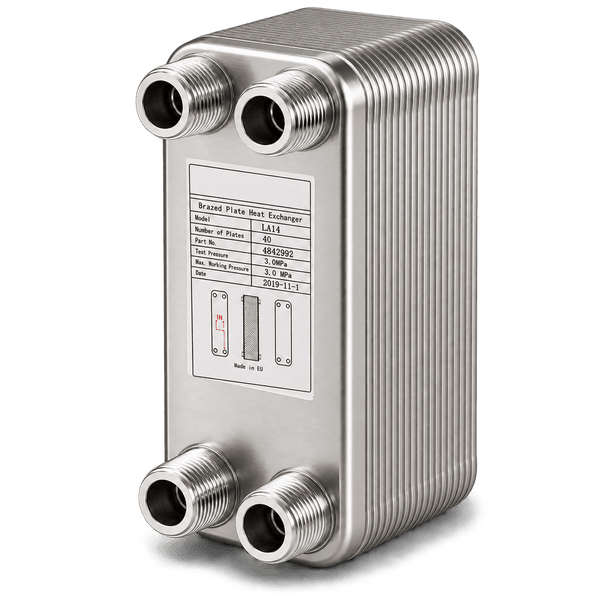
Nickel Brazed Plate
Nickel brazing exists for one main reason: ammonia destroys copper. Where the fluid rules out a copper brazed...
+ Learn More
Brazed Plate
Vacuum brazed 316 stainless with no gaskets, for clean duty where compactness and pressure matter.
+ Learn More