
1-805-484-2992
Quotes - Engineering - SalesDistillers Grains and Evaporation
Thin Stillage, Syrup and Condensate
Thin stillage goes to the evaporators dilute and leaves as syrup. Everything about the exchanger selection follows from what happens to the stream on the way.
After the beer column, whole stillage is separated. The wet cake goes to the dryer; the thin stillage goes to the evaporators, is concentrated to syrup, and is blended back with the cake to make distillers grains. Each of those steps has heat exchange around it, and the stream changes character as it goes.
Concentration changes the duty. Thin stillage entering the evaporator train and syrup leaving it are not the same fluid. Viscosity climbs, the transfer coefficient falls and the fouling rate rises with the solids content. A unit sized at the dilute end will underperform at the concentrated end, which is the most common disappointment on this part of the plant.
Free-flow is usually the answer. The stream carries fiber. A wide unobstructed channel passes it, and the pack opens for mechanical cleaning rather than relying on chemical circulation alone. The surface area penalty is real and it is worth paying.
Condensate is the clean side of the same process. Evaporator condensate is a recoverable low-grade heat stream and it is comparatively clean, so it takes a standard plate selection. Recovering it into process water or CIP make-up is usually straightforward once someone looks for it.
Size at the Concentrated End. The single most useful thing you can send for this duty is the range rather than a design point. Thin stillage at the front of the evaporator train and syrup at the back differ enough in viscosity and fouling behavior that a selection made for one will not serve the other.
Where a unit has to work across the range, it gets sized against the hard end. That costs surface area, and it is the difference between a unit that holds its duty through the campaign and one that is cleaned more often than the schedule allows.
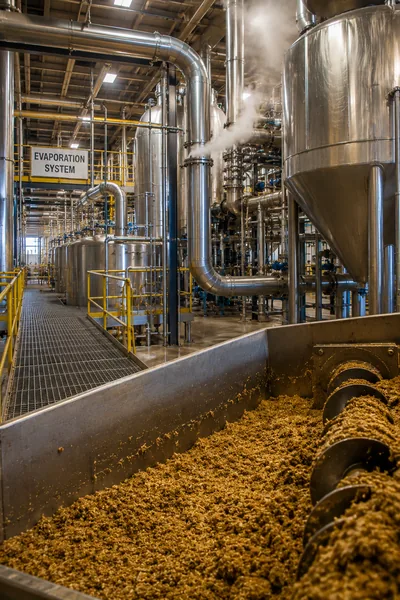
Evaporation and Stillage Duties
Duty Inputs
- Stream: Thin stillage or syrup
- Concentration: Range, not a single point
- Viscosity: At the concentrated end
- Flow and temperatures: Both sides
Typical Selection
- Free-flow plates on solids-laden duty
- Standard plate on condensate recovery
- Sized against the concentrated end
- Mechanical cleaning access
Select for syrup, not for dilute thin stillage
- Send the concentration range
- Free-flow plates where fiber runs
- Recover the clean condensate too
Before you specify
The wide channel has no contact points across it and generates less turbulence at a given velocity, so the heat transfer coefficient is lower and the area has to make up for it. That is the price of a pack that keeps running when fiber comes through. Ask for both plate types on the same duty and you can compare area and cost directly before deciding.
Measured values from your own syrup at two or more temperatures, taken at the most concentrated point the unit will see. Syrup viscosity moves sharply with temperature and dry matter, so a single literature figure can throw the sizing off badly. If your lab can say wether the syrup thins as it is pumped harder, include that as well.
Usually not. The two duties want different plates and very different cleaning intervals, and a shared frame means the clean condensate section comes apart every time the stillage side is opened. Divider sections make it possible when floor space is tight. Otherwise two seperate frames are easier to run and easier to clean.
CIP circulates caustic and acid and does well on thin films, but it struggles to shift a fiber mat packed into a channel. Mechanical cleaning means opening the frame and washing each plate by hand or with a pressure washer. Plan for both: CIP between openings and a mechanical clean at turnaround, with clear floor space in front of the movable end frame.
The peak temperature, the organic acids in the stream and the caustic in your CIP cycle, which is often the harshest condition the gasket meets. A compound that is happy with the process can still harden or swell under the cleaning step. Give us the hottest CIP temperature and the chemicals and strengths you run, along with the process conditions.
Related
Ethanol Production
From slurry to beer, a dry mill is a sequence of temperature steps. Each one is an exchanger, and each one...
+ Learn More
Beer & Stillage Interchange
The beer going to the column has to be heated. The stillage leaving it has to be cooled. Putting the two...
+ Learn More
Biofuels & Ethanol
A dry mill runs on heat it has already paid for once. The exchangers that cool mash, hold fermentation temperature and...
+ Learn More