
1-805-484-2992
Quotes - Engineering - SalesHEAT EXCHANGERS
Accu-Therm Plate & Frame Heat Exchangers
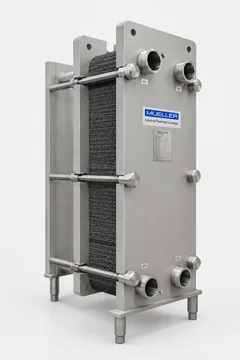
A stack of stamped metal plates, each individually gasketed, compressed between two end frames. It is the most thermally efficient exchanger in common industrial use, and the only one you can expand after it is installed.
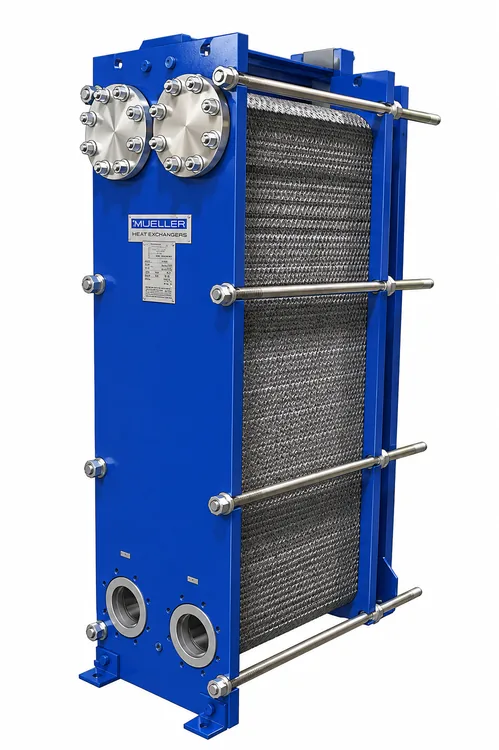
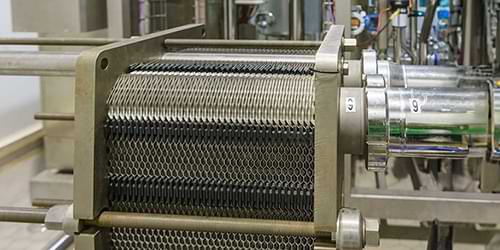
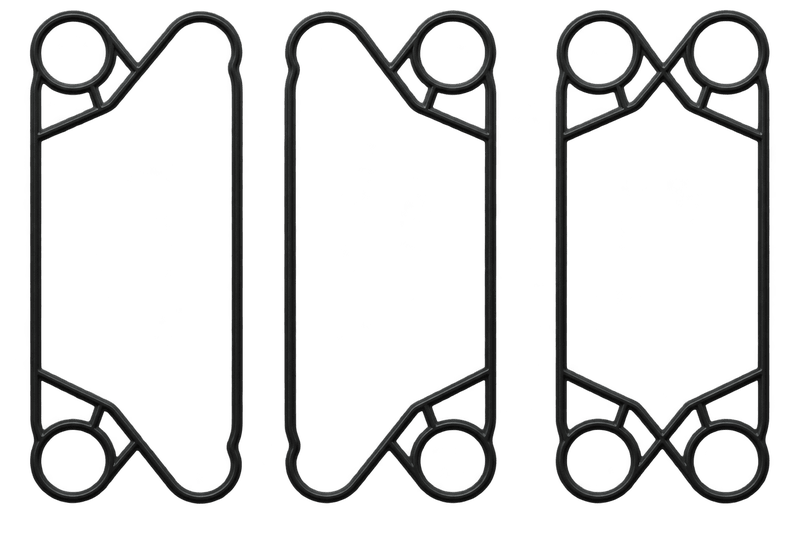
An Accu-Therm plate pack hangs on upper and lower guide rails between a fixed and a movable end frame, held together by compression bolts. Every plate is embossed with a corrugation pattern that forces turbulence at low fluid velocity, which is where the high heat transfer coefficient comes from. Because the plates are gasketed rather than welded, the whole pack opens for inspection and can be added to when the duty grows.


- True counterflow. Approach temperatures of 2 to 3°F are achievable, which is closer than a conventional exchanger will get you.
- Compact footprint. One fifth to one half the floor space of equivalent-duty equipment, and it is serviced in the same space it occupies.
- Expandable. Add plates within the existing frame as the duty grows, instead of buying a second exchanger.
- 100% inspectable. Remove the compression bolts, slide the movable frame back, and every square inch of heat transfer surface is in front of you.
- No cross contamination. Each medium is individually gasketed and the space between gaskets vents to atmosphere, so a gasket failure leaks outside rather than between streams.
- Drop-in frames. Custom frames can be built to land on an existing foundation and pipe run from another manufacturer, with no concrete or piping changes.


Accu-Therm Plate & Frame Heat Exchangers
Where the Efficiency Comes From
The corrugation pattern on an Accu-Therm plate does two things at once. It creates a very narrow channel, and it forces the fluid to change direction constantly as it travels. Turbulence at low velocity is the result, and turbulence is what breaks down the boundary layer that limits heat transfer against a smooth wall.
The practical consequence is a heat transfer coefficient several times higher than a conventional exchanger of the same duty, which is why the unit is so much smaller. It also means the plate exchanger reaches a much closer temperature approach, and on heat recovery duty that closeness is exactly what determines how much energy you actually recover.
Plates, Gaskets and What Limits Them
Plates are available in 304 and 316 stainless as standard, with titanium, Hastelloy and Incoloy for aggressive chemistry. Seven corrugation styles let the pack be tuned between high thermal efficiency and low pressure drop, and a single unit can mix patterns to balance the two.
Gaskets are the limit rather than the plates. Nitrile, EPDM, silicone, Viton/FKM and butyl each have their own temperature and chemical window, and picking the wrong compound is the most common reason a plate exchanger leaks after service. Typical maximum operating pressures run from 75 to 300 psig depending on plate and frame selection, with higher-pressure designs available.
When Plate and Frame Is Not the Answer
We would rather say this at quotation than have you find out later. Plate and frame struggles with very high pressure, with steam duty at large pressure drops, and with streams carrying large particulates unless you move to the Free-Flow plate. Gasket life is finite and it is a maintenance item.
Where those constraints bite, the honest recommendation may be a semi-welded pack, a brazed plate unit, or a Temp-Plate solution instead. All of them are Mueller products and we will point you at whichever fits.
Related
Accu-Therm Plate Exchangers
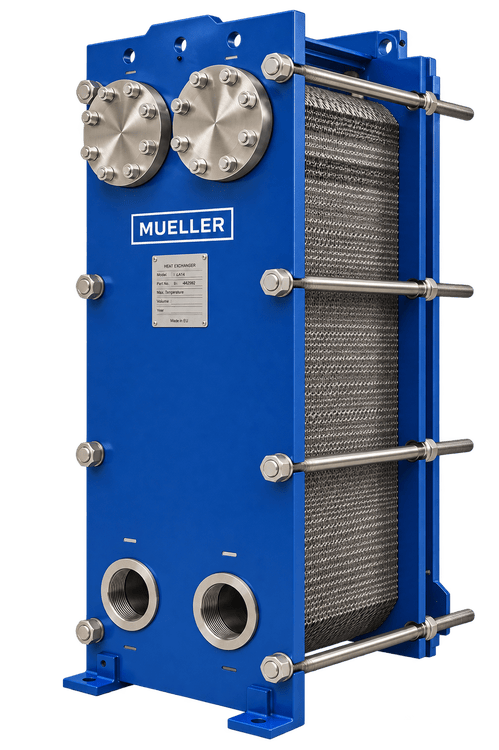
The original Accu-Therm, and the unit most of this line is built from. It handles simple fluids, viscous...
+ Learn More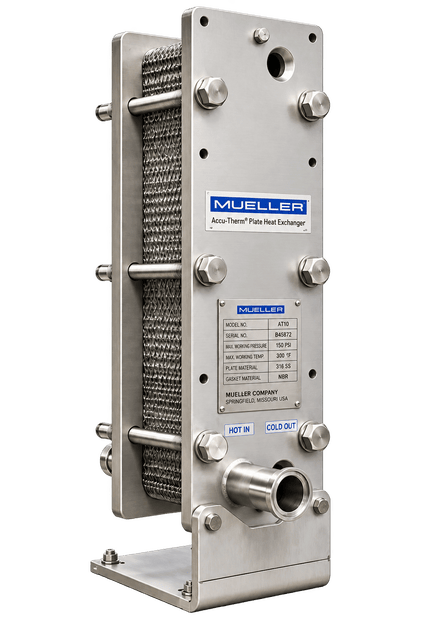
Sanitary Plate Exchangers
Sanitary duty asks two things at once: hit the thermal number, and prove afterward that the equipment can be...
+ Learn More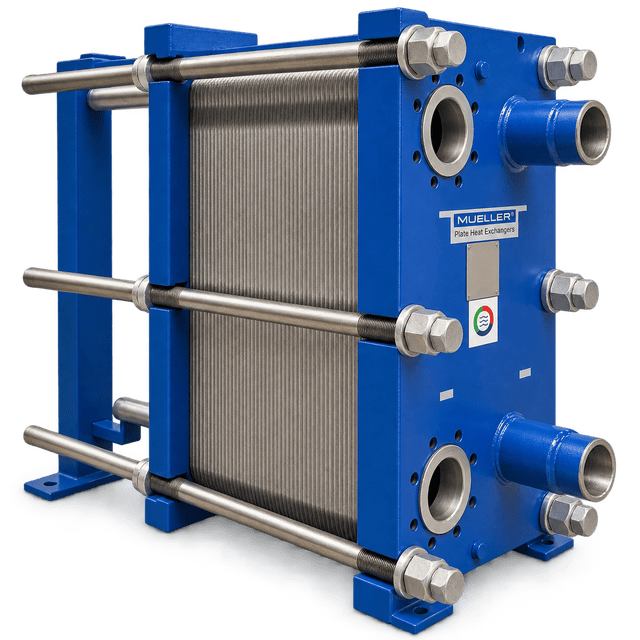
Semi-Welded Plate
Some fluids attack gaskets. Welding pairs of plates into cassettes puts those fluids inside a welded boundary...
+ Learn MoreBefore you specify
The fluid the gaskets would have to seal decides it. If either stream attacks the gasket compounds, as ammonia does with most elastomers, that stream belongs inside a welded cassette while the water side stays gasketed. When both sides are water, glycol or a mild process fluid, a fully gasketed pack costs less and is simpler to maintain. Name both fluids and we will tell you which construction the chemistry allows.
Pressure drop is the other half of every plate selection, and without it the rating has nothing to push against. A pack tuned purely for heat transfer can need more pump head than your system has, while one tuned for low drop carries plates you paid for and never needed. Give us a figure for each side, even a rough one, and the plate pattern mix gets chosen to land inside it.
You see fluid dripping from the edge of the pack, because the space between each pair of gaskets vents to the outside. That drip is a warning rather than a contamination event, so the sensible response is to schedule a regasket, not to scramble. Weeping that starts right after a pack was opened and closed usually means reused gaskets or a bolt-up that never reached its tightening dimension.
Size it for the duty you can reasonably foresee, not just this year's. Extra carrying bar and tie bolt length is cheap at purchase, while a frame with no headroom turns a later capacity increase into a second exchanger and new pipework. If a production increase or a new product is on the plan, give us the expected future load and we will quote a frame length that absorbs it.
On low and moderate steam pressure it works well, provided the gasket compound is chosen for steam, which normally means EPDM. Low-pressure steam takes up a large volume, so port size and condensate drainage often limit the selection before plate area does. High steam pressure or a steam side that must take a large pressure drop usually points to another construction. Send the inlet steam pressure and the condensing load and we will check both limits.
Often it can, because the frame is built to suit the footprint instead of the footprint being rebuilt around the frame. What decides it is the anchor bolt pattern, the nozzle centerlines and elevations, and which end the piping enters from. Measure those, add the old nameplate data and the present duty, and we can say whether a custom frame lands without concrete or pipe changes.