
1-805-484-2992
Quotes - Engineering - SalesMetal Finishing & Plating
Plating, Anodizing and Quench Duty
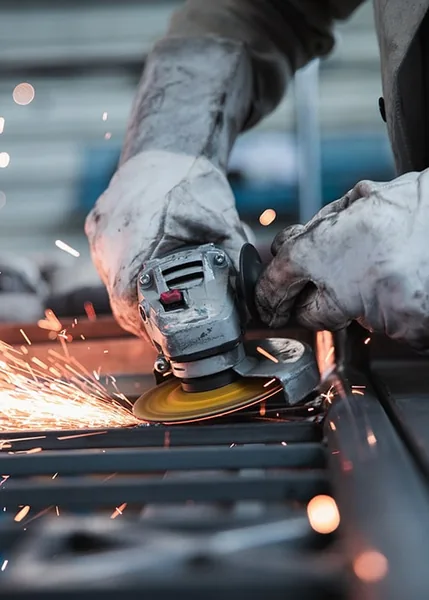
Plating and finishing lines are full of hot aggressive tanks that need temperature control and nothing in them that will survive an elastomer.
Metal finishing needs heaters and coolers on plating solutions, anodizing baths, pickling tanks, strike solutions and quench oil, plus cooling for welders, induction heaters and hydraulics.
Immersion is the usual answer for tanks. A Temp-Plate immersion assembly is fully welded with no gaskets, which is precisely what a hot acid or caustic bath demands. Alloy and finish are selected against the chemistry.
Clamp-on for retrofits. Where a tank already exists and needs temperature control it never had, a clamp-on jacket bolts to the outside without cutting the vessel.
Utility side. Seal water coolers, welder cooling, induction heater cooling and hydraulic oil cooling are all straightforward plate exchanger duties, usually against tower water.
Typical Specification
- Tank duty: Temp-Plate immersion assemblies
- Retrofit: Clamp-on jacket panels
- Typical baths: Plating, anodizing, pickling, strike solutions
- Quench oil: Plate exchanger, sized on peak burst load
- Utility cooling: Welders, induction heaters, hydraulics, seal water
- Materials: Selected against bath chemistry
- Construction: Fully welded; no gaskets in the bath
- Cooling source: Usually tower water via isolation exchanger
- Control: Medium temperature controlled to protect the bath
- Cleaning: Assemblies designed for removal where required
Getting heat into a hot, aggressive tank
- No gaskets in the bath
- Sized on heat-up time
- Clamp-on where the tank exists
Specifying questions
On the heat-up time you want from cold, plus the steady loss from the open surface, ventilation and parts going in. Heat-up usually governs, so a line that wants the bath ready an hour after start needs far more surface than one allowed to warm overnight. Give us the bath volume, solution type, start and operating temperatures, and how quickly the tank must come up.
Along a side wall or end, clear of the work zone and anode bars, with space behind for solution to circulate. Panels jammed against the wall or buried in sludge loose much of their rating. Agitation or air sparging past the surface helps a great deal, so tell us whether the tank has it when we size the assembly.
Most do, because the anodizing current dumps a steady load of heat into the bath and hard coat lines run cold. A Temp-Plate immersion assembly on chilled glycol is a common arrangement. The rectifier rating and duty cycle give the heat load closely, so send those along with the target bath temperature.
Flat or gently curved steel walls that can take welded lugs on the outside, with enough clear area between stiffeners to mount a useful panel. Lined or plastic tanks are a poor fit, since heat has to pass through the liner. Output depends on tight contact with the shell, so a conductive mastic between panel and wall is normally part of the installation.
Some plating chemistries break down or drop additives if the heater wall runs much hotter than the bath. Hot spots also bake deposits onto the panel, which cuts output and is hard to remove. Running steam or hot water at a moderate temperature and controlling it closely keeps the panel surface near bath temperature and protects the chemistry.
Behind a plate exchanger on tower water, so the closed loop running through torches, transformers and coils stays clean and treated. Those passages are small, and one slug of tower scale can starve an induction coil. Keep the closed side on deionized or inhibited water as the equipment requires, and size the plate pack for the hottest summer tower temperature.
Related
Chemical Processing
Chemical plants ask more of alloy selection than anyone else, and they ask it about the film at the surface...
+ Learn More
Pulp & Paper
Paper mills run some of the dirtiest and most alkaline streams in industry, and most of them carry heat worth...
+ Learn More
Power Generation
Power plants run auxiliary cooling circuits that nobody notices until one of them stops, and most of them are...
+ Learn More