
1-805-484-2992
Quotes - Engineering - SalesDrum & Roll Cooling
Rotating Surfaces and Uniform Temperature
Chill rolls, flaker drums and drying drums all need one thing above everything else: a uniform surface temperature across the working face. That is what Temp-Plate inflated wall construction delivers.
Drum and roll duty applies heat transfer to a rotating cylindrical surface. Molten product is applied and solidified for flaking, viscous film is cooled, or wet material is dried against a heated drum.
Uniformity is product quality. A cold spot produces thicker flake, a warm spot produces product that will not release. On a chill roll the film thickness follows the surface temperature directly, so uniformity is not a refinement, it is the specification.
Why inflated construction. Internal coils cool the drum wall only where they touch it. Inflated wall construction puts the flow passage continuously behind the working surface, which produces a far more even face.
Sizing inputs. Drum diameter and width, rotational speed, film thickness, the medium and its temperature, and how product is applied and removed. Doctor blade and knife arrangements are part of the same conversation.
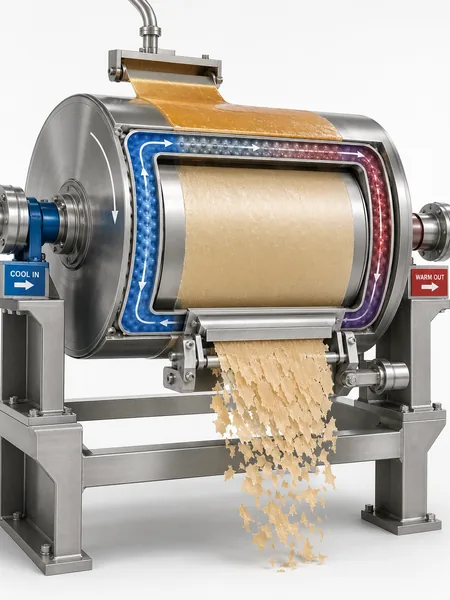
Cooling or heating a rotating cylinder whose outer face carries a product film, where the internal flow passage must hold the whole working face at one temperature so the film forms and releases evenly.
What engineers check first
Uniform enough that flake thickness or film release does not change across the face, and the product sets that tolerance. Waxes and resins with a sharp solidification point are very sensitive, while broad-melting products tolerate more variation. Tell us how the product behaves near its set point and where quality complaints show up today, such as one edge producing thicker flake.
A rotary joint at one or both journals passes the medium in and out while the drum turns. Its size and rating limit the flow and pressure available, so on a retrofit the existing joint is part of the check. Send the joint details along with the drum drawing, including the journal bore.
Medium warms as it travels, so the face runs coolest where the medium enters and warmest where it leaves. A higher flow rate keeps that rise small, at the cost of a larger pump and rotary joint. Tell us the medium temperature rise you can accept across the drum, and we check it against the uniformity the product needs.
Faster rotation shortens contact time, so each part of the film spends less time on the cold face and leaves warmer. Throughput rises, but only if the surface can still remove heat fast enough to solidify the film before the knife. Give us the speed range you run so the medium temperature and flow can be checked at the top end.
The finish affects how cleanly product releases at the knife or doctor blade, and it wears over time. Tell us whether the product sticks and what the blade is made of, since that steers the face material and finish. Corrosive or abrasive products may change the surface material entirely.
With no flow, the face drifts toward ambient quickly and product on it softens, sticks or fails to solidify, so production has to stop. A flow switch on the medium return, interlocked to the product feed, stops the line before the face loses temperature. Tell us how the line is controlled today so the interlock fits it.
Related

Tank Jacket Retrofit
A tank that needs heating or cooling it does not have usually presents two expensive options: replace it, or...
+ Learn More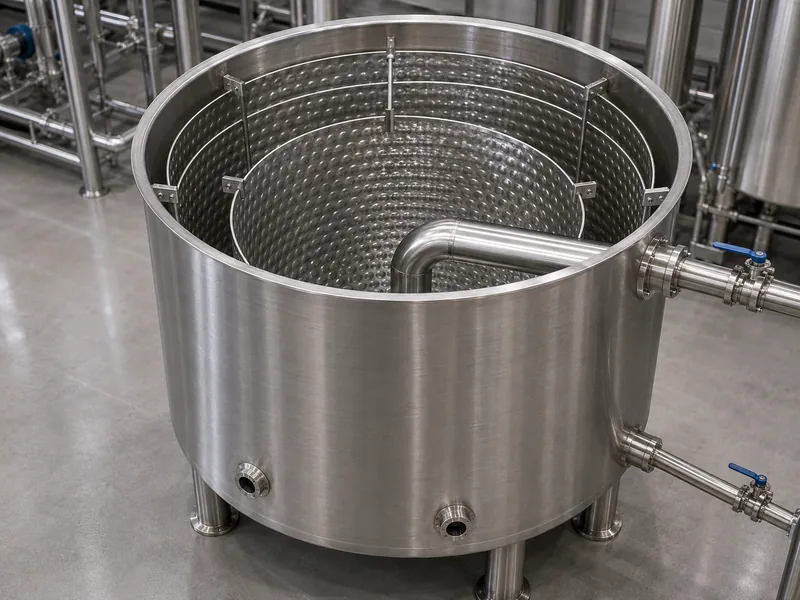
Immersion Tank Heating
Some fluids cannot be pumped out to an exchanger. They are too viscous, too abrasive, too valuable, or the...
+ Learn More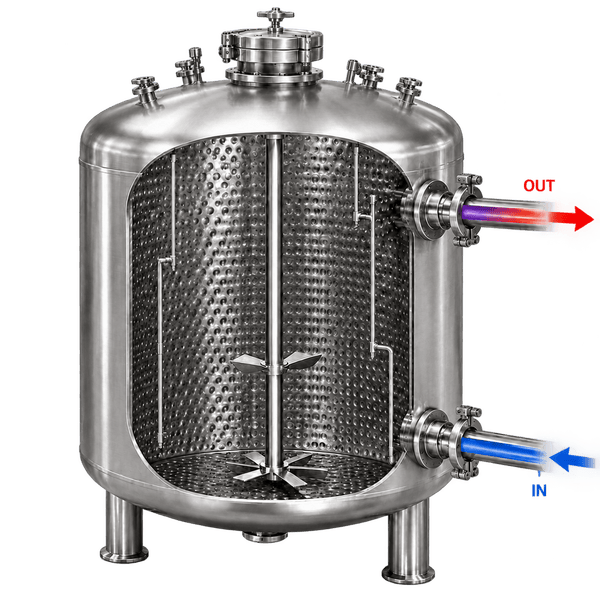
Vessel & Reactor Cooling
Reaction heat has to leave at the rate it is produced, and the consequence of it not leaving is rarely just a...
+ Learn More