
1-805-484-2992
Quotes - Engineering - Sales4x8 Falling Film Chiller
High Capacity Evaporator Format
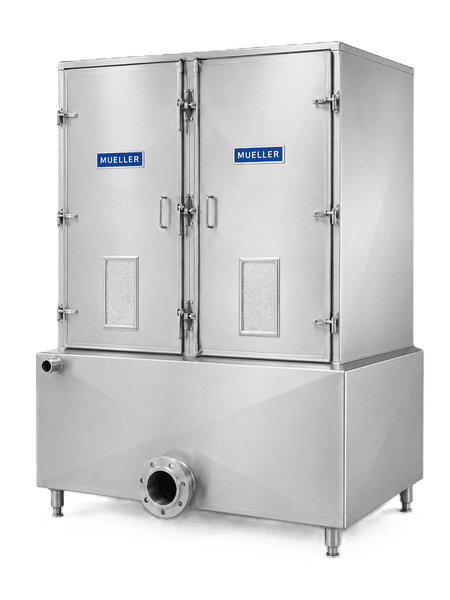
The larger evaporator plate format, for duties where a 3x5 cabinet would need more plates than it can hold or where floor space per unit of capacity matters.
4x8 plates carry substantially more capacity each, so fewer plates reach a given duty. On large hydrocooling and process water systems this is usually the more economical route.
Fewer, larger plates. Each 4x8 plate does the work of several smaller ones, so a large hydrocooler or process water chiller reaches its duty with a short plate count and a cabinet that stays manageable on the floor. If the load will grow, ask for empty plate positions when the cabinet is ordered.
Matching the refrigeration plant. At this size the chiller is usually one load on a central ammonia or halocarbon system. The suction temperature, the refrigerant and the way the evaporator is fed are agreed with whoever runs that plant, at the same time as the water duty.
Setting the water duty. Give us the flow, the warm water coming back to the chiller and the temperature you need leaving it. If the chilled water touches product, as it does in hydrocooling, say so, since that sets the sanitation specification and can change materials.
Typical Specification
- Evaporator plates: 4x8 Temp-Plate format
- Cabinet: Fully enclosed
- Plate count: Selected to meet the required capacity
- Freeze protection: Built into the Temp-Plate evaporator
- Secondary exchanger: Not required
- Tank: Integral or tankless
- Materials: Stainless steel construction
- Cleaning: Plates and distribution accessible
- Water duty: Flow, inlet and outlet temperature
- Refrigerant: Matched to the condensing arrangement
| PRODUCT | CONSTRUCTION | MATERIALS | SUPPLY |
| 4x8 Falling Film Chiller | Mueller factory built | 304 / 316 stainless | New equipment |
Request a QuoteChoose the 4x8 when a 3x5 cabinet would run out of plate positions before it runs out of duty.
4x8 cabinet: when to step up
4x8 Falling Film Chiller
Sizing the Cabinet
Choose the plate count for the load you have now, and choose the cabinet for the load you expect. Spare plate positions cost little at purchase. A second chiller later means another cabinet, more floor space and more piping.
A selection made on the water side alone can ask the refrigeration plant for more suction capacity than it has spare. Both sides are sized together, on the plant's real suction conditions.
Application questions
Large, continuous loads where a 3x5 cabinet would run out of plate positions. Each 4x8 plate carries much more capacity, so fewer plates and fewer refrigerant feeds reach the same tonnage. Plants with high daily water use and a central refrigeration system usually find the larger format cheaper per unit of cooling.
Hydrocooling is one of its main duties. Return water from the cooler carries soil, leaves and field heat, so screen it before it reaches the distribution pan and plan a regular washdown. The volume of water a hydrocooler recirculates is what pushes most produce operations to the larger plate.
Poultry chillers and meat plants use near-freezing water in volume, which is exactly where the larger plate fits. Because the water touches product, the enclosed cabinet and the cleaning access become part of the plant hygiene program. Tell us the inspection standard your plant works to so the specification can reflect it.
The tank does most of the work, banking chilled water during light periods so the plates can catch up after a heavy draw. A larger tank lets a smaller refrigeration plant keep pace with a peaky load. Send the load profile across the shift, not just the peak, and the tank and plate count are balanced together.
It can, provided the feed method and the suction temperature at the chiller suit the duty. Large plants often feed evaporators by recirculation, and the chiller is connected to that system like any other evaporator. Tell us the refrigerant, the feed method and the suction temperature available at the location.
The plates are larger, so washdown takes longer, but access works the same way as on the smaller formats. Plan a platform or step if the top of the plates and the distribution pan sit above comfortable reach. Fewer plates for the same capacity also means fewer surfaces to clean overall.
Related
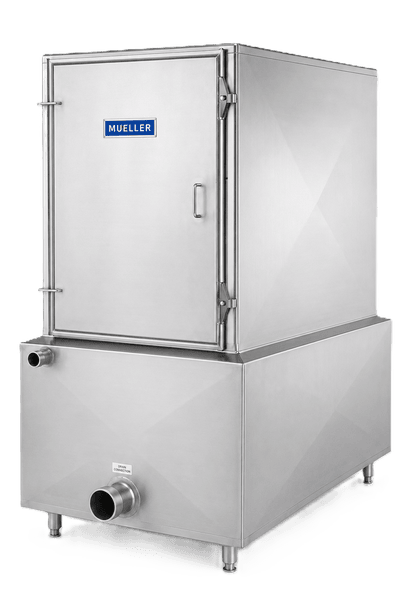
3x3 Falling Film Chiller
The smallest cabinet in the range, and the one that fits where floor space decided the specification: a...
+ Learn More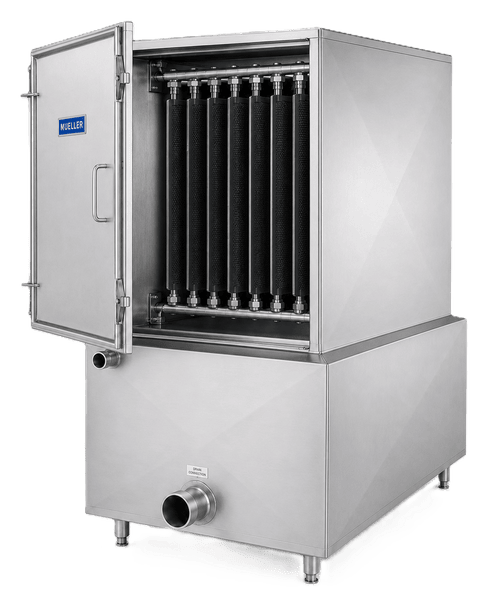
3x5 Falling Film Chiller
The smaller of the two evaporator plate formats, and the one that covers most bakery, brewery and mid-size...
+ Learn More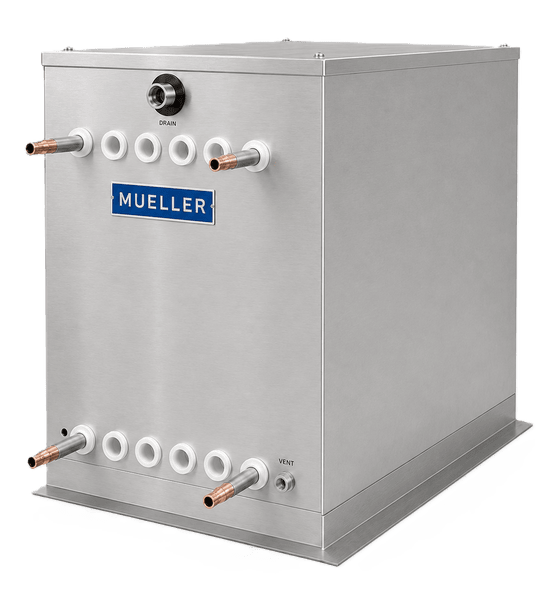
Tankless Chillers
If the plant already has chilled water storage, an integral sump is a tank you are buying twice. Tankless...
+ Learn More