
1-805-484-2992
Quotes - Engineering - SalesThermal Sizing
Rating Against Your Actual Duty
Sizing is where the difference between a unit that works for a decade and one that disappoints in a season is decided, and it takes about ten minutes of your information.
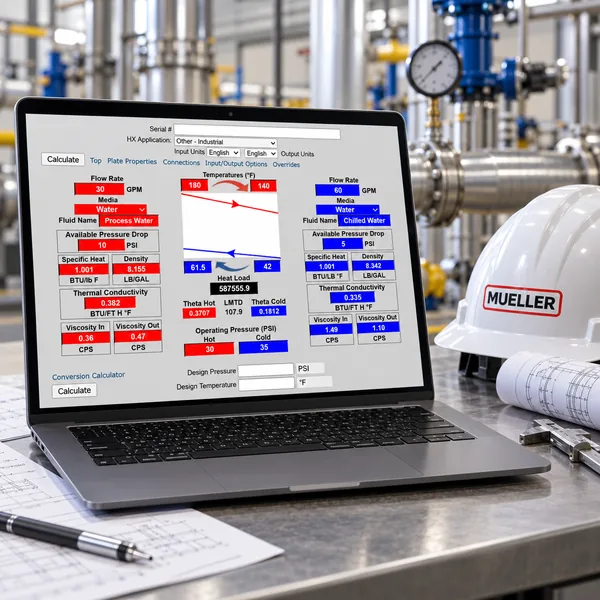
A thermal rating balances the heat transfer requirement against the pressure drop available, on both sides, at the fouling condition you expect.
The design point is the easy part. A selection is judged on the range around that point: how far the unit turns down, how much the cooling water swings between seasons, and the transient it sees at start-up or on an upset.
Pressure drop is the usual omission. A unit selected on thermal duty alone can meet the temperature and be impossible to pump through at the flow the system delivers. It is the most common cause of a rejected selection.
Fouling allowance. Over-generous allowance produces excess surface and low velocity, which encourages the deposition it was meant to cover. Real experience beats a default value.
Typical Specification
- Thermal inputs: Both fluids, flows, inlet and outlet temperatures
- Hydraulic inputs: Allowable pressure drop each side
- Mechanical inputs: Operating and design pressure and temperature
- Fouling: From experience where available
- Turndown: Range as well as design point
- Seasonal: Cooling water temperature variation
- Materials: Selected against stream and cleaning chemistry
- Output: Plate count, pattern, frame and connection selection
- Expansion: Frame space specified where growth is expected
- Documentation: Rating summary supplied with the quotation
Send the duty
Fluids, flows, temperatures and the pressure drop each side allows
Define the range
Turndown, seasonal water swings and start-up transients alongside design
Set fouling margin
Base the allowance on plant history, not a default figure
Review the rating
Check plate count, frame and connections against your system
Rating questions
The driving temperature difference shrinks as the approach tightens, and required area climbs steeply as that difference narrows. Plate units handle close approaches better than most constructions because the flow is true counterflow, but each step tighter still costs surface and pressure drop. Ask for the approach the process really needs, and let us show you the area at a slightly wider one for comparison.
Passes raise velocity on a side with low flow, which lifts the coefficient when one stream is much smaller than the other. The cost is higher pressure drop and connections on the movable end, which means disconnecting pipe to open the pack. We use passes where a single pass would leave channels underloaded, and we tell you when the trade is not worth it.
Give viscosity at two or more temperatures across the operating range, or the fluid name and concentration if it is a standard medium such as glycol. Viscosity changes so much with temperature that a single value at room temperature can misstate the cold end of the unit badly. For non-Newtonian products, say so and describe how the material behaves when pumped or stirred.
Confirm the inlet temperatures and flows match the data you sent, that the pressure drop on each side fits your pumps, and that the margin over the clean requirement matches the fouling you expect. Look at channel velocity too, since a low figure warns of faster fouling. If anything differs from your information, ask before approving rather then after delivery.
Related
Replacing Another Brand
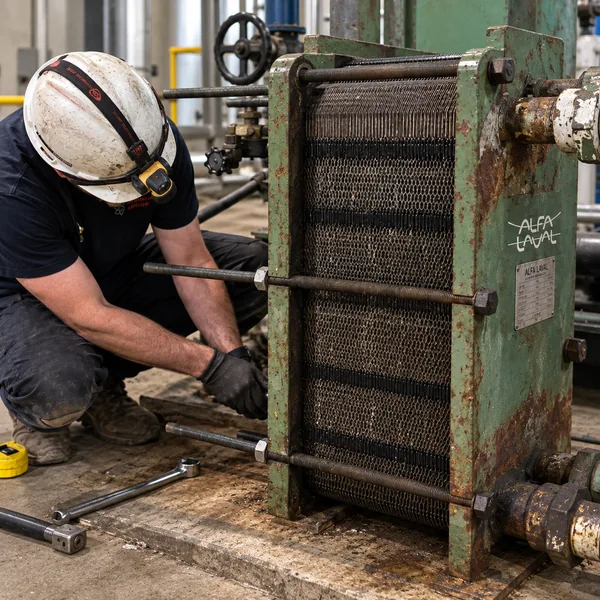
Replacing a competitor's plate exchanger does not have to mean new concrete and new pipework. Custom frames...
+ Learn More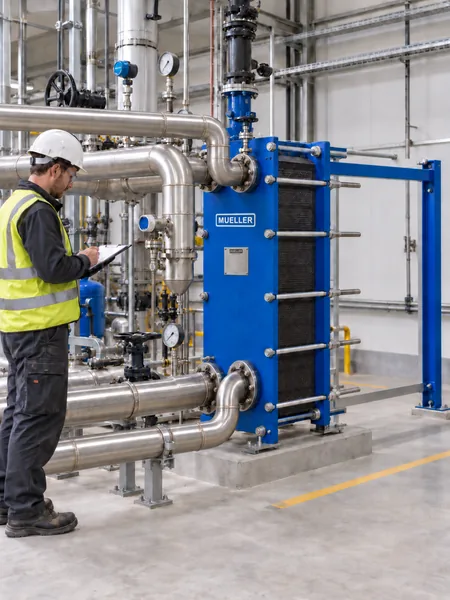
Installation & Startup
Most early plate exchanger problems are installation problems, and almost all of them are avoidable with an...
+ Learn More
Engineering & Selection
Every unit we quote is rated against your actual conditions before it is priced, so the selection is settled before the number is.
+ Learn More