
1-805-484-2992
Quotes - Engineering - SalesHEAT EXCHANGERS
Temp-Plate Inflated Heat Transfer
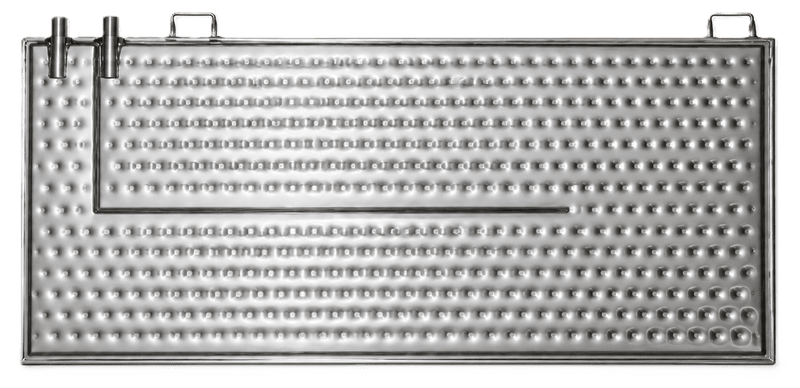
Two sheets of metal, spot welded in a pattern, seam welded around the edge and then inflated with pressure. What you get is a heat transfer surface that can be formed into almost any shape and welded wherever the heat needs to go.
Temp-Plate is made by spot or laser welding two sheets together and continuously seam welding the perimeter, creating a pressure-retaining boundary. Hydraulic inflation then expands the unwelded areas into pillows, forming the flow passage. The result is fully welded with no gaskets and no parts to replace, and because it is fabricated rather than assembled it can be formed to fit the equipment you already have.
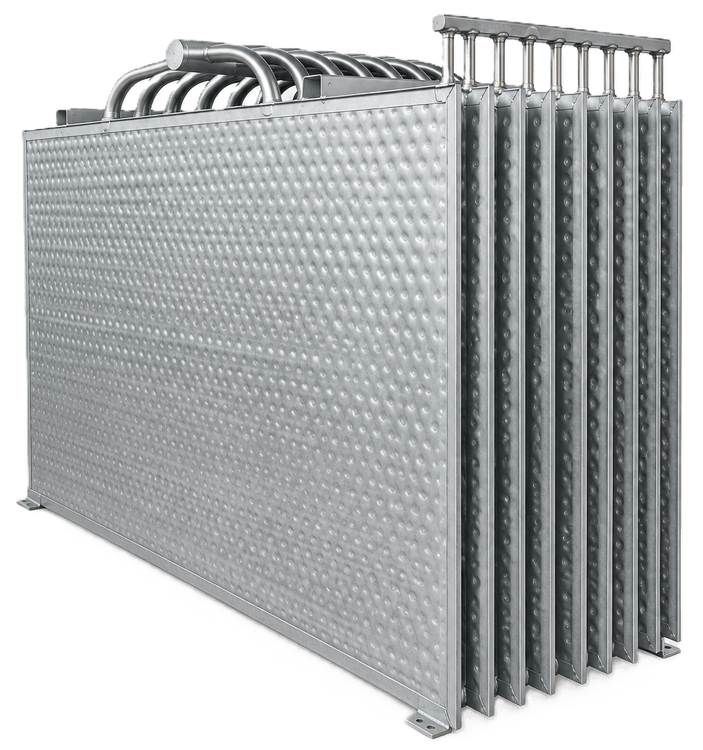



- Lower media volume. Far less heating or cooling fluid has to be pumped through a Temp-Plate jacket than through traditional dimple jacketing, which shows up directly in pump cost.
- Formed to shape. Panels can be rolled, formed and welded to nearly any geometry, so heat transfer surface goes where a conventional jacket cannot follow.
- Fully welded. No gaskets, no elastomers, nothing to replace on a schedule. In corrosive or high-temperature service that removes the usual failure point.
- Wall-to-wall contact. The inflated pattern gives a continuous surface with no gaps, unlike a coil, which touches the vessel only along its own run.
- Panels to 60 x 240 inches. A single panel can be fabricated up to roughly 60 by 240 inches depending on material and thickness, and assemblies combine panels beyond that.
- Over fifty years of it. Mueller has been designing and building inflated pillow plate since the 1960s, and the assembly types below are the standard ways it gets applied.
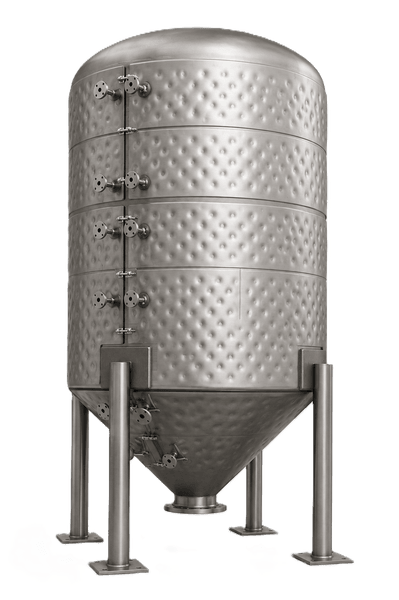
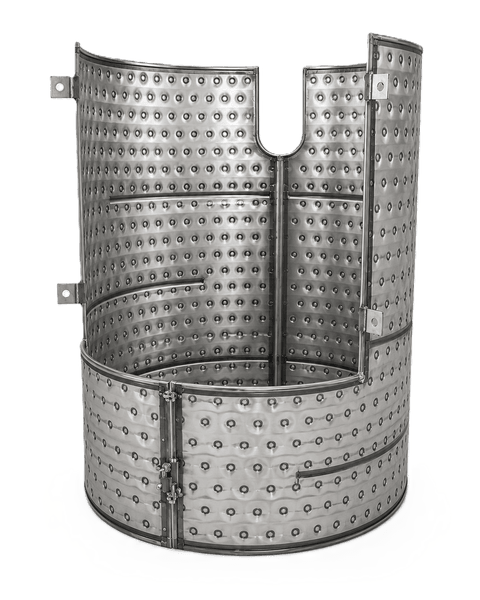
Temp-Plate Inflated Heat Transfer
Single Embossed or Double Embossed
Double embossed panels are inflated on both sides and are the usual choice for direct immersion and for clamp-on jackets, where the pillow pattern on the vessel side is filled with heat transfer mastic. They also cost less than single embossed.
Single embossed panels have one flat face, which matters when the panel forms part of the product contact surface. A heated trough or a conveyor bed built from single embossed Temp-Plate presents a smooth face to product while carrying the heating medium behind it.
Where Temp-Plate Beats a Coil or a Jacket
Against a tube coil, Temp-Plate gives continuous surface contact instead of line contact, and it is far easier to clean around. Against traditional dimple jacketing, it needs less media volume and can be applied without cutting into the vessel.
The place a coil still wins is very high pressure on the media side and very small vessels where a formed panel is awkward. We will say so if that is where your duty lands.
Materials and Thickness
Stainless 304 and 316 cover most work, with carbon steel where the environment allows and titanium and higher alloys where the chemistry demands. Material thickness combinations are chosen against design pressure, forming requirements and whether the panel is single or double embossed.
Clamp-on panels are usually supplied in 304 or 316 stainless or carbon steel. If the vessel is an unusual alloy, the tank mounting lugs can be supplied in that alloy while the panels themselves stay in a more economical material.
Related
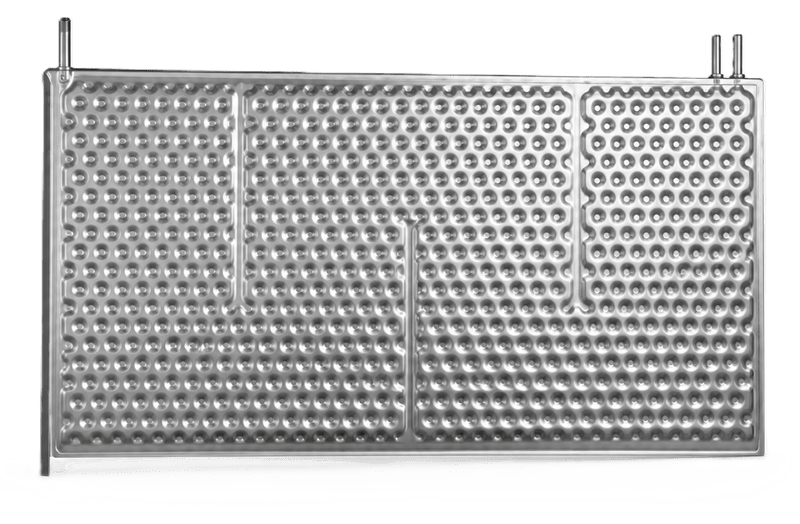
Immersion Assembly
Some fluids cannot be pumped out to an exchanger and back. They are too viscous, too valuable, too abrasive...
+ Learn More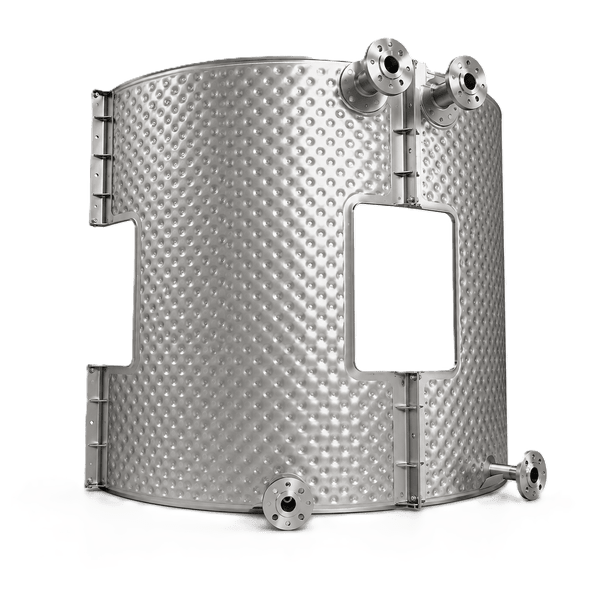
Clamp-On Assembly
If a tank you already own needs heating or cooling it does not have, the usual answer is expensive: replace...
+ Learn More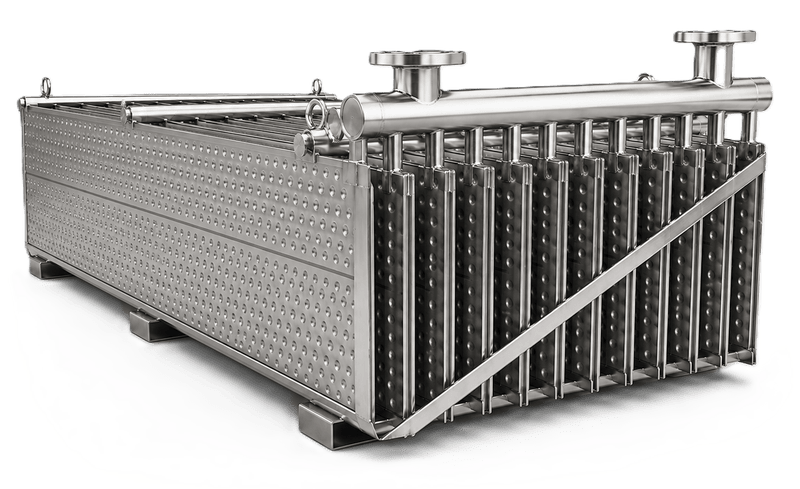
Bank Assembly
A bank is a set of inflated plates hung in parallel with product flowing between them. It gives you very fast...
+ Learn MoreChoosing a model
Start with where the heat has to go and whether the vessel can take anything inside it. Immersion puts surface in the liquid itself, so it transfers more per square foot and suits open tanks, plating lines and batches that can not be pumped. Clamp-on stays outside the shell and keeps the interior clear for agitators, cleaning and product contact. If the tank has internals or a sanitary interior, clamp-on usually settles it.
A bank assembly, because product moves through wide open gaps between plates rather than through a narrow channel. Whole produce, poultry and fibrous mash pass without bridging, and the plates lift out for washdown. Expect a bigger footprint than a closed exchanger on the same duty, since velocity between the plates is low. Tell us the largest piece that has to pass and the hourly throughput.
Designing it in is almost always cheaper. An integral assembly makes the heated wall and the component one fabrication, so there is no second jacket to build, fit and weld on. Once the equipment exists, the clamp-on route becomes the practical one because it goes on without cutting the shell. OEMs still at the drawing stage should raise the heating or cooling need before drawings are released.
It changes the panel design more than the assembly type. Steam condenses at a near constant temperature, so the pillow pattern mainly has to drain condensate and hold the pressure. Glycol, chilled water and hot oil depend on velocity through the passages, which puts the attention on flow pattern and pass arrangement. Give us the medium, its supply temperature and the pressure available at the connection.