
1-805-484-2992
Quotes - Engineering - SalesCopper Brazed Plate
The Standard Braze Material
Copper brazing is the default, and for the great majority of duties it is also the right answer. It is cheaper than nickel, thermally excellent and entirely suitable for anything that is not going to attack copper.
In a copper brazed unit, 316 stainless plates are stacked with copper foil between them and taken through a vacuum furnace. The copper melts and wicks into every plate contact point, forming a brazed joint at each one. The result is a monolithic block where every contact point is also a structural bond, which is where the pressure capability comes from.
Where it is used. HVAC heating and cooling coils, hydraulic and lube oil cooling, domestic hot water generation, halocarbon refrigerant evaporators and condensers, and small heat recovery duties throughout industry.
What rules it out. Ammonia attacks copper, so ammonia refrigeration systems require nickel brazing. Certain amines and some water chemistries also argue against copper. Where there is any doubt about the fluid, that is the conversation to have before ordering.
Sizing. Plate count sets capacity within a model family, and connection size and type are selected to suit the pipework. Because the units are compact and frequently stocked, lead times are usually short.
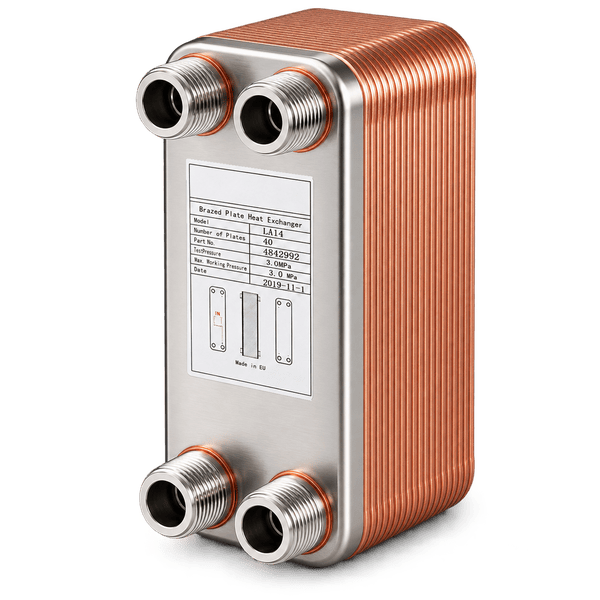
Typical Specification
- Plates: Type 316 stainless
- Braze material: Copper
- Construction: Vacuum brazed monolithic block
- Gaskets: None
- Typical duty: HVAC, oil cooling, domestic hot water, halocarbon refrigerant
- Not suitable for: Ammonia and fluids that attack copper
- Pressure: High; model dependent
- Connections: Threaded, soldered or flanged to suit
- Cleaning: Chemical circulation only
- Availability: Many sizes stocked for rapid shipment
| PRODUCT | CONSTRUCTION | MATERIALS | SUPPLY |
| Copper Brazed Plate | Mueller factory built | 304 / 316 stainless | New equipment |
Request a QuoteChoose copper braze whenever the fluid leaves copper alone, and put the selection effort into water quality rather than the braze metal.
Copper braze: where to focus
Copper Brazed Plate
Fouling Is the Design Question
A copper brazed unit is entirely reliable on clean duty and unforgiving on dirty duty, because it cannot be opened. Water quality on an open cooling loop is therefore the thing to establish before selecting one.
Where water quality is questionable, a strainer ahead of the unit and a chemical cleaning regime will extend life considerably. Where it is genuinely poor, a gasketed Accu-Therm is the better long-term purchase.
Design questions
Anything that dissolves copper pipe will dissolve the braze joints, and those joints are what hold the block together. Watch for water treatment programs that use ammonia compounds, sulfide-bearing well water, low pH and aggressive softened water. A recent water analysis settles most cases, and where it shows a problem, nickel braze is the safer selection.
In most installations it is, because the water already runs through copper piping in the same building. The plates are 316 stainless, and the braze is a small exposed area at each contact point. Where local water is known to pit copper tube or leave blue staining, the same chemistry will shorten the life of the braze, so mention it.
Fresh inhibited glycol is fine and is one of the most common copper brazed duties. The risk comes later, when the inhibitor is spent and the glycol turns acidic as it ages and oxidizes. That acidic fluid attacks copper from the inside, so test the loop each year and top up the inhibitor before the pH drifts low.
On a closed, treated loop it is good practice, and on any open loop it is close to mandatory. Weld slag, pipe scale and gasket fragments from commissioning are the usual culprits, and one piece lodged at a port can block a set of channels permanently. Fit the strainer where it can be cleaned without draining the unit, with gauges either side to show when it loads up.
Related
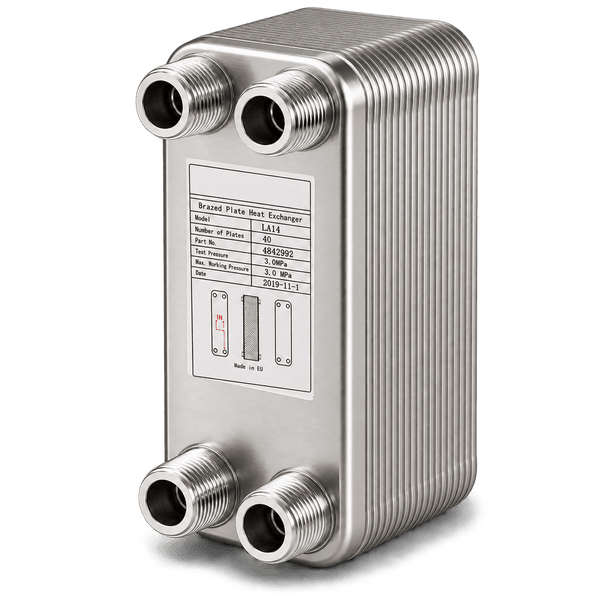
Nickel Brazed Plate
Nickel brazing exists for one main reason: ammonia destroys copper. Where the fluid rules out a copper brazed...
+ Learn More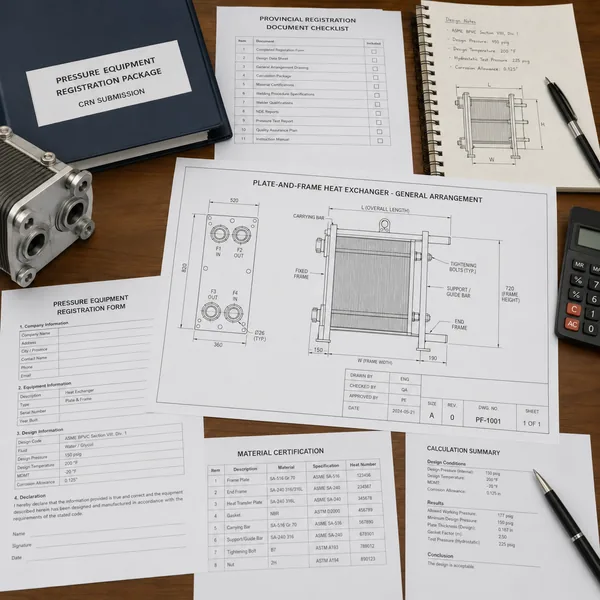
Sizing & Selection
Brazed plate units are cheap enough that people buy them from a table. That works untill it does not, and when...
+ Learn More
Brazed Plate
Vacuum brazed 316 stainless with no gaskets, for clean duty where compactness and pressure matter.
+ Learn More