
1-805-484-2992
Quotes - Engineering - SalesPetroleum & Refining
Hydrocarbon and Gas Processing Duty
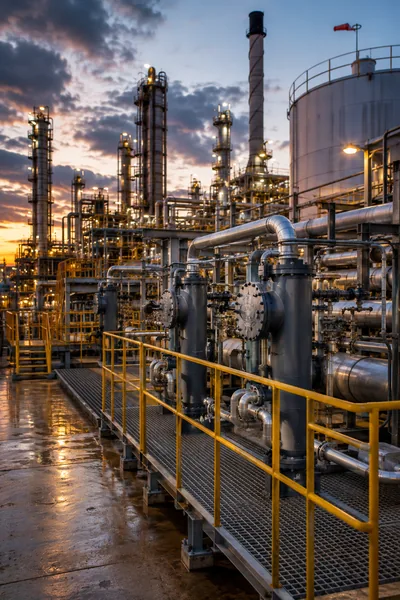
Refining and gas processing duty brings hydrocarbons, high temperatures and gasket compatibility questions that decide the selection before thermal design begins.
Petroleum duty covers oil refining, natural gas processing, offshore installations and petrochemical plants, with interchangers, seal water coolers, hydraulic oil cooling and process water isolation among the common applications.
Gaskets first. Hydrocarbons attack many elastomers. Viton and other fluoroelastomers handle most of them; nitrile and EPDM frequently do not. Where no gasket suits, semi-welded or Temp-Plate construction removes the question.
Offshore. Weight and footprint matter more offshore than almost anywhere, and a plate pack occupying a fraction of the space of a tubular unit of the same duty is a direct structural saving.
Titanium for seawater. Where seawater is the cooling medium, titanium is the standard plate material and copper alloys are not an option in a plate pack.
Typical Specification
- Typical duty: Interchangers, seal water, hydraulic oil, process isolation
- Gasket selection: Fluoroelastomer for most hydrocarbons
- Where no gasket suits: Semi-welded or Temp-Plate construction
- Seawater cooling: Titanium plates
- Offshore: Weight and footprint advantage over tubular
- High temperature: Plate and gasket selected together
- Pressure: Frame selected for the design pressure
- Cleaning: Frame opens for inspection
- Materials: 304, 316, titanium, higher alloys
- Documentation: Material certificates supplied
Hydrocarbon service starts with the gasket question
- Full hydrocarbon composition sent
- Titanium on any seawater side
- Semi-welded where elastomers fail
Questions on fit
Aromatics such as benzene, toluene and xylene swell many elastomers that handle straight paraffins without trouble. A gasket that looks fine on a crude or diesel compatibility chart can fail on a reformate or solvent stream. Give us the aromatic fraction along with the temperture range, because it often moves the choice to a fluoroelastomer grade or to semi-welded construction.
On light, clean crudes at modest pressure it can be, and the close approach recovers heat a tubular train leaves behind. Heavy crudes carrying wax, asphaltenes or sand are a different story, as the narrow channels foul and pressure drop climbs. We look at viscosity at the cold end and solids content before recommending a plate pack.
Lean and rich amine interchange and glycol cooling suit plates well, since both are clean, moderate temperature streams where close approach saves reboiler energy. Gasket compatibility with the amine and any carried-over hydrocarbon has to be checked. Degraded amine and heat stable salts raise the corrosion risk, so tell us the amine type and its condition.
Plates go to titanium, and the seawater connections need port linings or titanium nozzles as well. Marine growth and silt foul the seawater channels, so upstream strainers and a frame that can be opened on deck are part of the design. Allow a fouling margin on the seawater side and leave access space around the unit for pulling plates.
Related
Chemical Processing
Chemical plants ask more of alloy selection than anyone else, and they ask it about the film at the surface...
+ Learn More
Metal Finishing & Plating
Plating and finishing lines are full of hot aggressive tanks that need temperature control and nothing in...
+ Learn More
Pulp & Paper
Paper mills run some of the dirtiest and most alkaline streams in industry, and most of them carry heat worth...
+ Learn More