
1-805-484-2992
Quotes - Engineering - SalesChemical Processing
Aggressive Chemistry and Corrosion
Chemical plants ask more of alloy selection than anyone else, and they ask it about the film at the surface rather than the bulk stream that produced it.
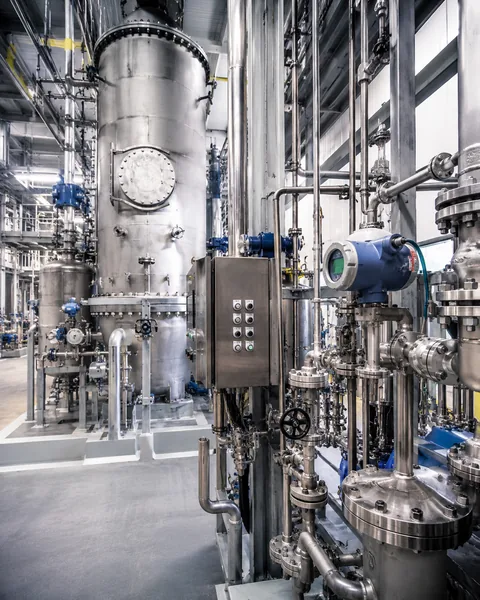
Chemical processing covers interchangers, brine heating and cooling, acid duty, gas scrubber service, salt refining and process water isolation. What they share is that material selection is the design problem.
Select against the film. The first liquid to condense or the last to evaporate concentrates whatever is aggressive into a small volume at the surface. That film, not the bulk analysis, is what corrodes.
Alloys available. 304 and 316 stainless for general duty, titanium for chlorides, Hastelloy and Incoloy for acids and high temperature. Gasket compound is selected alongside, and it is frequently the binding constraint rather than the plate.
Tanks and reactors. Where the fluid cannot be pumped through an exchanger, Temp-Plate immersion and jacket assemblies put heat transfer into the vessel, fully welded with no elastomer to attack.
Typical Specification
- Typical duty: Interchangers, brine, acid, scrubbers, salt refining
- Plate materials: 304, 316, titanium, Hastelloy, Incoloy
- Gaskets: Compound selected against the process and cleaning chemistry
- Selection basis: Film chemistry at the surface, not bulk analysis
- Vessel duty: Temp-Plate immersion and jacket assemblies
- Solids: Free-Flow plate where particulates are present
- Pressure: Frame selected for the design pressure
- Cleaning: Frame opens for inspection and mechanical cleaning
- Containment: Interspace vented; double-wall where required
- Documentation: Material certificates supplied
Material selection starts at the wall, not the feed
- Trace species listed with the stream
- Cleaning chemistry checked against gaskets
- Alloy matched to the surface film
Questions from operators
Run the stream's phase behavior across the exchanger temperatures rather than trusting the averaged lab analysis. Where the stream partly condenses or boils inside the pack, acids and salts collect in a thin layer at the wall at concentrations far above the feed. A corrosion coupon in the existing line, or a deposit sample from a unit already in service, tells you more than any bulk number.
Every one used in the clean-in-place or manual cleaning cycle, at the temperature it is applied. Operators often check the process fluid carefully and forget that a hot nitric or caustic wash can swell or harden a gasket faster than the product does. List the cleaning agents, strengths and wash temperatures with the process data so the compound is picked for both.
When the fluid can be pumped through narrow channels without solids settling or viscosity climbing out of reach. A plate pack gives far more surface per unit volume and a closer approach. A Temp-Plate assembly wins where the material must stay in the reactor or tank, where it carries heavy solids, or where any elastomer in contact with the chemistry is unacceptable.
Material certificates for the plates and wetted parts are supplied, which most chemical plants need for their management of change file. If your site requires specific traceability, positive material identification or a particular certificate format, say so at the inquiry stage. Adding those requests after the order is placed tends to slow release of the unit.
Related
Metal Finishing & Plating
Plating and finishing lines are full of hot aggressive tanks that need temperature control and nothing in...
+ Learn More
Pulp & Paper
Paper mills run some of the dirtiest and most alkaline streams in industry, and most of them carry heat worth...
+ Learn More
Power Generation
Power plants run auxiliary cooling circuits that nobody notices until one of them stops, and most of them are...
+ Learn More