
1-805-484-2992
Quotes - Engineering - SalesHEAT EXCHANGERS
Accu-Therm Plate & Frame, Temp-Plate, Chillers and Farm Coolers
Mueller has built heat transfer equipment since 1940, and the range divides cleanly into two families: plates that fluid flows between, and inflated panels that put surface directly against whatever needs heating or cooling. Nearly every duty we quote is one or the other.
Mueller has built heat transfer equipment since 1940, and the range divides cleanly into two families: plates that fluid flows between, and inflated panels that put surface directly against whatever needs heating or cooling. Nearly every duty we quote is one or the other.
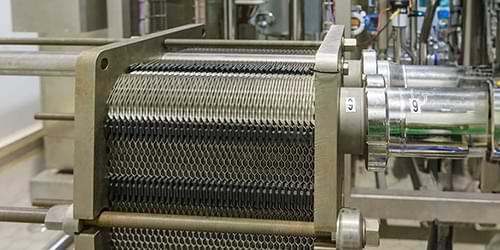
Plate & Frame
The core Mueller plate line: true counterflow, expandable packs, and full access to every surface.
SELECT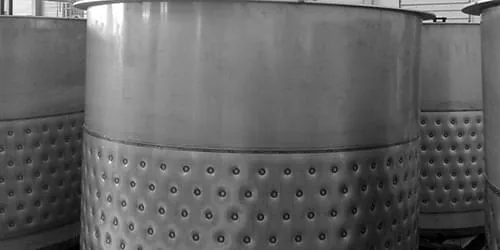
Temp-Plate Dimple Jackets
Spot-welded inflated panels that put heat transfer surface exactly where a conventional jacket cannot go.
SELECT
Falling Film Chillers
Temp-Plate evaporator plates chill water directly, with no glycol loop and no secondary exchanger.
SELECT
Brazed Plate
Vacuum brazed 316 stainless with no gaskets, for clean duty where compactness and pressure matter.
SELECTChoosing Between the Mueller Technologies
Can the Fluid Be Pumped Through an Exchanger?
That single question routes most inquiries. If both fluids can be pumped, an Accu-Therm plate and frame exchanger is normally the most efficient answer available: corrugated plates create turbulence at low velocity, giving a very high heat transfer coefficient, a temperature approach of two to three degrees and a unit occupying a fraction of the floor space of the alternatives.
If the fluid cannot be pumped, or the thing needing heat is a tank rather than a stream, Temp-Plate is the answer. Inflated panels are formed to shape and hung inside a vessel, bolted to the outside of one, or welded into a component so heat transfer becomes part of the equipment itself.
The Rest of the Line Is Those Two Technologies Applied
A falling film chiller is a Temp-Plate evaporator with water running down its face, which is why it chills water directly with no secondary loop and no freeze-up. A brazed plate unit is a plate pack with the gaskets and frame removed and the whole thing brazed into a sealed block.
Understanding that makes the range far easier to navigate. Once you know whether your duty is a plate problem or a panel problem, the specific product usually chooses itself.
What Decides the Specification
Material follows the chemistry at the surface rather than the bulk stream. Gasket compound follows the temperature and the cleaning regime, and on many duties it is the binding constraint rather than the plate. Pressure drop decides plate pattern and frequently the whole selection, and it is the input most often left off an inquiry.
Send both fluids with flow rates, inlet and required outlet temperatures, pressures and the allowable pressure drop on each side, and the unit will be rated before it is priced.




Where to start
Start with the size and nature of the solids, not the pump. Fibers and pulp up to a modest size will pass the open channel of an Accu-Therm Free-Flow plate, while a standard chevron plate bridges and blocks within weeks. Once the solids are heavy or abrasive, a Temp-Plate bank with plates that lift out for cleaning is the safer purchase. Tell us what the solids are and roughly how large.
Often, and the split usually follows the process. A dairy or juice line may pasteurize the moving product on an Accu-Therm unit, then hold it in a vessel whose wall carries a Temp-Plate jacket. Quoting both together lets one set of utility temperatures and one cleaning chemistry serve the whole job, so send the full process sketch rather than two separate requests.
On heat recovery and free cooling, where every degree of approach is a degree of energy you either keep or lose. A plate pack running true counterflow can bring the leaving stream within two to three degrees of the entering one. On a simple heating duty with plenty of temperature difference, that closeness buys little, and a smaller unit with a wider approach is the better spend.
Plate packs cope with moderately thick liquids, but pressure drop climbs steeply as viscosity rises and the narrow gap becomes the limit. Syrups, creams and heavy slurries that are mixed in a tank are usually easier to heat or cool through a jacket or immersion panel while an agitator moves them. Send viscosity at both the inlet and outlet temperature, since it can change several times over across the duty.
A gasketed frame bought with spare length takes more plates on the same rails, which makes it the easiest to expand. A falling film chiller cabinet can accept extra evaporator plates if it was built with open positions. Temp-Plate grows by adding panels or bank plates where the vessel allows. Brazed units are fixed at the plate count they left the furnace with, so size those for tomorrow.