
1-805-484-2992
Quotes - Engineering - SalesLeak Testing & Inspection
Confirming Integrity After Service
A pressure test after reassembly costs an hour. Finding a misplaced gasket by putting product through the unit costs considerably more.
Testing after service confirms that the pack is sealed, that no gasket has been displaced during assembly and that no plate has been damaged.
Hydrostatic test. Each circuit is pressurized independently and held, which finds both external leaks and, with the correct arrangement, cross-circuit leaks between the two fluids.
Plate inspection. With the pack open, plates are checked for pitting, cracking around the ports and erosion at the inlet. Damage clustered at one location usually indicates a flow or chemistry problem rather than plate wear.
What findings mean. Pitting suggests the plate material is wrong for the service. Cracking at the port suggests mechanical stress or over-compression. Both are worth acting on rather than simply replacing the plate.
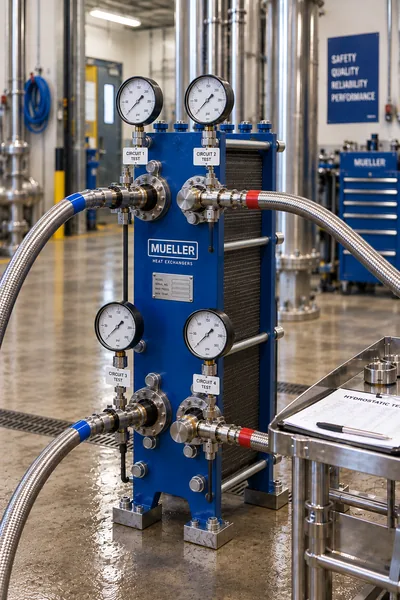
Typical Specification
- Test type: Hydrostatic, each circuit independently
- Finds: External leaks and cross-circuit leaks
- Timing: After any service that opens the pack
- Plate checks: Pitting, port cracking, inlet erosion
- Pitting: Indicates material unsuited to the service
- Port cracking: Indicates mechanical stress or over-compression
- Records: Test results logged against the unit
- Frequency: Whenever the pack is opened
- Gaskets: Renewed before testing
- Follow-up: Findings addressed rather than only repaired
Renew the gaskets
Fit a fresh set before the pack goes under pressure
Test each circuit
Hydro one side at a time and watch the other
Inspect the plates
Look for pitting, port cracks and erosion at the inlet
Log and follow up
Record results by serial and act on the cause
Questions on this job
Pressurize one circuit with the other drained and its connections open, then watch the open side for liquid. Any flow there means a breach between circuits, almost always a hole or crack in a plate. Pinholes to small to show during a short hold can be traced afterward with dye penetrant on the opened plates.
From the design pressure on the nameplate and the code the unit was built to, not from whatever the plant system happens to run at. Going beyond the documented test pressure can distort plates or push a gasket out of its groove. Hold each side long enough for the gauge to settle, and record the pressure, hold time and result against the serial number.
Fine cracks and pinholes that pass so little fluid they never register on a gauge. Penetrant on a clean, opened plate shows them as colored lines or dots, usually near the ports or where the corrugations take load. Where mixing the two fluids is unacceptable, such as potable water or food product against a coolant, it is worth running on every plate at major services.
Log each plate by its position in the pack along with what you found, from pitting and cracks to thinning and deposits. Photographs keyed to those position numbers turn the next inspection into a comparison instead of a fresh look. Over a few openings the record shows whether damage is spreading, holding steady or confined to one region of the pack.
Any time the pack dimension changes, a retest is the only proof the seal has held. Tightening to stop a weep can hide a gasket that has rolled out of its groove, and that gasket then lets go at the next temperature swing. If the weep returns after tightening within the specified range, open the pack and find the cause.
Related
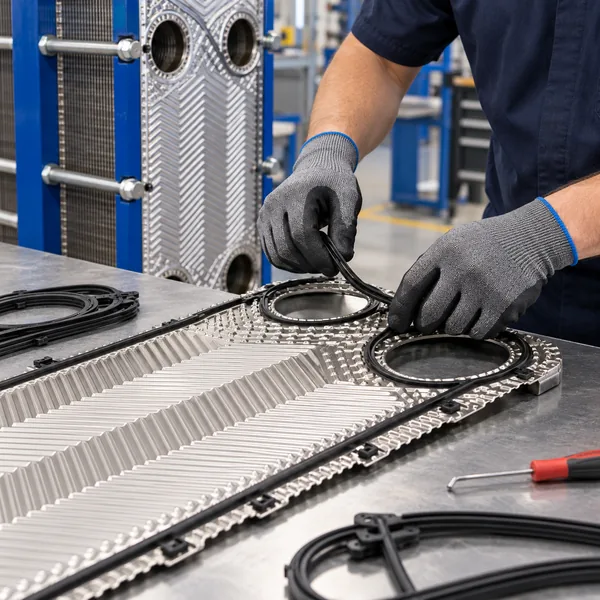
Regasketing
Gaskets are the shortest-lived component in a plate exchanger and the cheapest to renew. Doing it properly is...
+ Learn More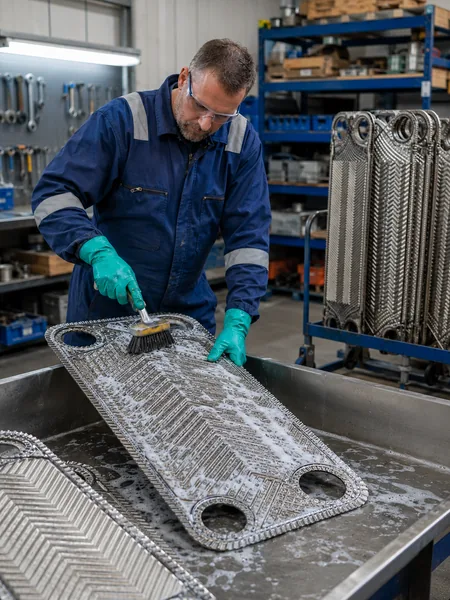
Plate Cleaning
Fouled plates lose duty gradually and quietly. Cleaning them restores it, and how you clean depends entirely...
+ Learn More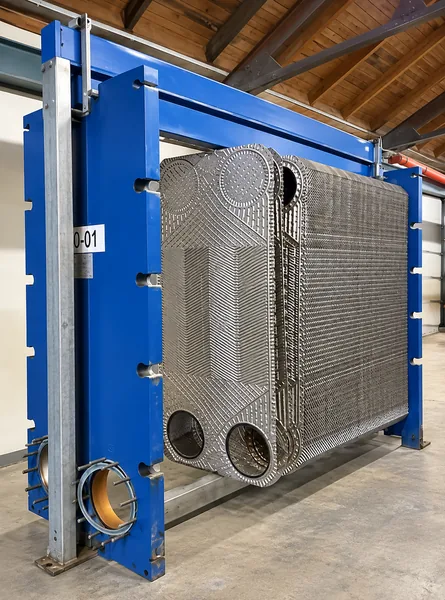
Plate Pack Expansion
Adding plates to an existing frame is the cheapest capacity increase available, and it is only possible if...
+ Learn More