
1-805-484-2992
Quotes - Engineering - SalesGeothermal & Heat Pump
Ground Loop and Heat Pump Isolation
Ground loops and heat pump systems live on small temperature differences, which makes the exchanger approach a much larger fraction of the available driving force than it is elsewhere.
Geothermal and heat pump systems use exchangers to isolate the ground loop from the building loop, to separate pond or open water sources, and to interface heat pumps with distribution systems.
Small delta T amplifies approach. Ground loops operate on modest temperature differences, so an exchanger consuming three degrees takes a much larger share of the available driving force than the same exchanger on a steam duty would.
Open source loops. Pond, lake and well water sources need isolation because they foul and because they carry whatever is in them. Plate material follows the water chemistry.
Glycol on the ground side. Antifreeze in the ground loop raises viscosity and lowers the coefficient, and the exchanger must be sized on the glycol properties rather than water.
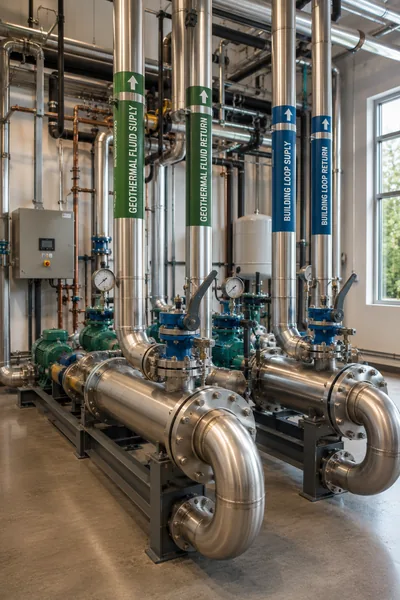
Typical Specification
- Application: Ground loop, pond and open source isolation
- Key metric: Approach temperature against small available delta T
- Ground loop fluid: Water or glycol; sized on actual fluid properties
- Open source: Pond, lake and well water isolation
- Materials: Selected against source water chemistry
- Fouling: Open source side opens for cleaning
- Heat pump interface: Exchanger between heat pump and distribution
- Reversibility: Sized for both heating and cooling modes
- Footprint: Small plant room requirement
- Expansion: Plates added within the frame
Ground source selection points before the order
- Sized on real glycol properties
- Both heating and cooling modes checked
- Source water side opens for cleaning
Application questions
It follows the water analysis, especially chlorides, dissolved iron and anything that feeds biological growth. Fresh well water with low chloride content usually suits stainless, while brackish or saline wells push toward titanium. Send a water test with the inquiry, because guessing the source chemistry is how a ground source plate pack ends up pitted within a few seasons.
The temperature program flips, and the mode with the smaller driving force usually sets the plate count. Selecting on cooling alone and checking heating afterward can leave one season short. We run both cases at selection and confirm the streams stay in counterflow in each, since piping that is counterflow in summer can end up parallel in winter if valves swap the streams.
The concentration actually in the loop, which is often stronger than the drawings show after a contractor tops it up before a cold winter. A richer mix thickens further at low temperature and can cut the coefficient noticeably. Size on the worst case you expect to see, and tell us whether the fluid is propylene or ethylene glycol, since the two behave differently.
Related
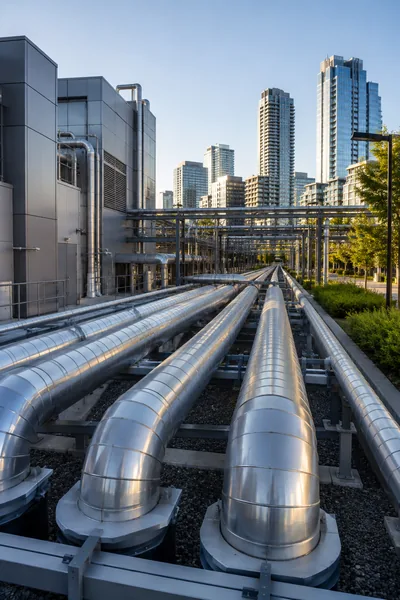
District Energy
District systems live or die on the temperature difference they can maintain between supply and return, and...
+ Learn More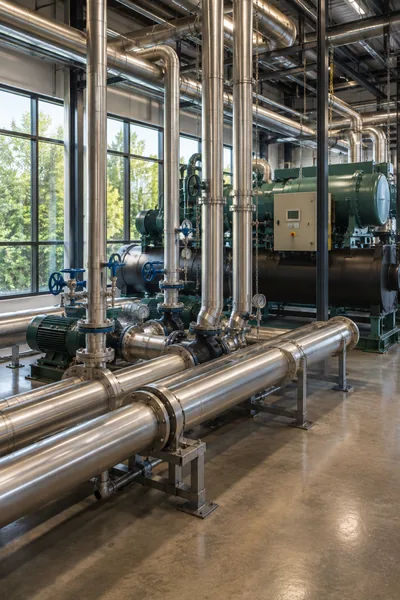
Water-Side Economizer
When the wet bulb is low enough the cooling tower can meet the load on its own and the chillers can stop. The...
+ Learn More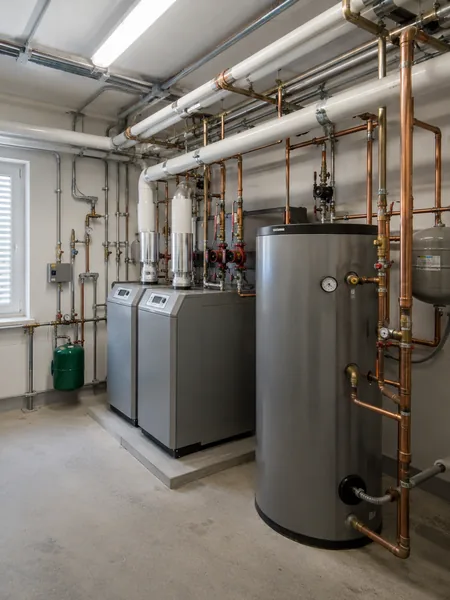
Domestic Water Heating
Heating potable water with a non-potable fluid raises a question no thermal calculation answers: what happens...
+ Learn More