
1-805-484-2992
Quotes - Engineering - SalesSanitary Plate Heat Exchangers
Built for Product Contact
Sanitary duty asks two things at once: hit the thermal number, and prove afterward that the equipment can be cleaned. A gasketed plate pack answers the second question better than almost anything, because every surface opens up for inspection.
The sanitary Accu-Therm is designed to meet or surpass the requirements for equipment handling product intended for human consumption. It is the unit behind a very large share of pasteurizers, wort coolers, juice chillers and ingredient heaters in North America.
Product contact surfaces. Type 316 stainless plates as standard for the product side, with 304 stainless end frames and stainless compression bolts that carry no paint to crack or peel. The surface finish and gasket groove detail are chosen so nothing holds residue between production runs.
Cleaning that can be verified. Clean-in-place handles routine duty, and when a cleaning claim needs to be demonstrated the frame opens and every plate is examined individually. That is the argument no welded or brazed exchanger can make.
Regeneration. On pasteurizing duty the same frame commonly carries regeneration, heating and cooling sections separated by connector grids. Recovering heat between incoming cold product and outgoing hot product is where the operating cost of a pasteurizer is decided.
Part numbers. Every cataloged model, with the dimensions and ratings that separate them: Accu-Therm Sanitary Part Numbers (16 part numbers).
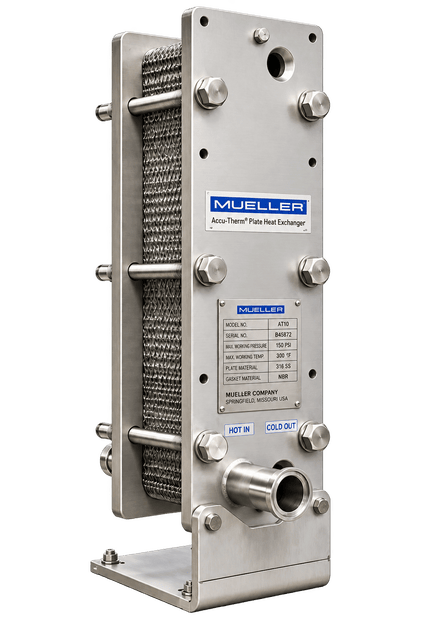
Common to the Whole Series
Configuration
- Connection Type: Sanitary ferrule / tri-clamp; S-line, Q-line, Victaulic
- Passes: Multi-pass with divider sections
- Plate Thickness: 0.5 mm
- Wall Construction: Single wall gasketed, sanitary
Materials
- Frame: Painted carbon steel or 304 SS; stainless hanger
- Gasket: NBR or EPDM (FDA, 3-A) 302°F; EPDM High-Temp 329°F
- Plate: 316 SS standard; 304 SS, titanium optional
- Surface Finish: Sanitary polish, CIP capable (Ra not published by Mueller)
Ratings
- Max Temperature: 302°F (FDA gaskets) / 329°F (high-temp EPDM)
- Max Working Pressure: 150 PSI sanitary service
- Min Temperature: 32°F
Typical Specification
- Product contact: Type 316 stainless plates
- End frames: Type 304 stainless, unpainted
- Compression bolts: Stainless steel
- Gaskets: FDA compliant compounds; snap-in on many models
- Connections: Sanitary ferrule standard; others available
- Cleaning: CIP capable; frame opens for manual inspection
- Sections: Single or multi-section with connector grids
- Regeneration: Available within the same frame
- Typical duty: Pasteurizing, product heating and chilling, wort cooling
- Pressure differential: Arranged so product side stays above utility side
| PRODUCT | CONSTRUCTION | MATERIALS | SUPPLY |
| Sanitary Plate Heat Exchangers | Mueller factory built | 304 / 316 stainless | New equipment |
Sanitary Plate Heat Exchangers
Pressure Differential Is Not Optional
On pasteurizing duty the pressure on the pasteurized side must exceed the pressure on the raw side at all times, so that any leak in the regeneration section flows from safe to unsafe rather than the reverse. That is a regulatory requirement rather than a design preference and it constrains pump placement and valve arrangement across the whole system.
It also stresses gaskets, which is one reason gasket compound selection matters more on a pasteurizer than almost anywhere else.
Fouling Is Burn-On, Not Scale
Protein denaturation at the heating surface is what shortens run length on dairy and protein duty, and it depends on the surface temperature rather than the bulk temperature. A hotter medium with less surface produces shorter runs between cleans.
Lowering the heating medium temperature and adding plate area usually lengthens run time enough to pay for the extra surface within a season.
Accu-Therm Sanitary Part Numbers
Plate & Frame Part Numbers
Sanitary construction is not a different exchanger, it is a different specification of the same frames — and it is offered in four sizes rather than the full range. AT4, AT10, AT20 and AT40 are the ones built this way.
What sanitary changes. The connections, the surface finish, the gasket compound and the way the frame is finished so it can be cleaned rather than merely washed. The thermal selection is unchanged; the specification around it is not.
The -SAN, C-10, F-10 and B-10 spellings all appear on nameplates. Where a suffix pattern was inferred from observed nameplates rather than published literature, the pass notes say so.
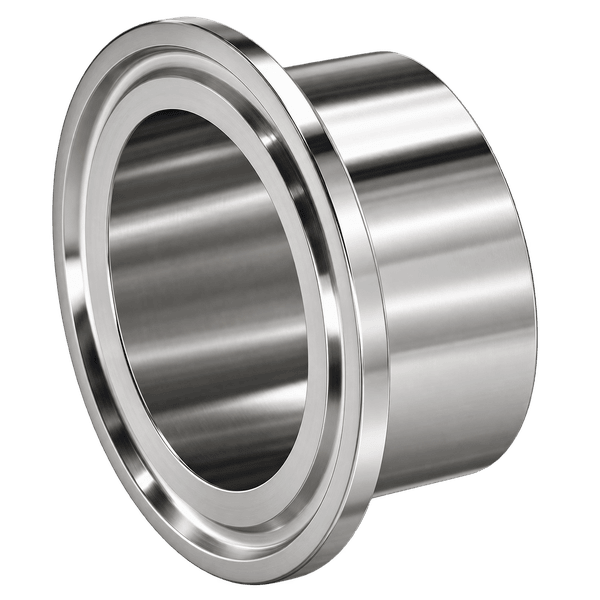
Accu-Therm Sanitary Part Numbers
Why Only Four Sizes
Sanitary duty is a food, dairy, beverage and pharmaceutical business, and the flows involved sit inside what these four frames cover. If your duty is larger than an AT40 in sanitary trim, that is a conversation rather than a catalog lookup — call us before you design around a size that is not built.
Gaskets Are the Sanitary Decision
The plate material rarely decides a sanitary job; the gasket compound usually does. Cleaning chemistry, temperature and wether the gasket contacts product all point at a different compound, and the wrong one shows up as a short gasket life rather than an immediate failure.
Tell us the CIP regime along with the duty. It is the input most often left out of a sanitary inquiry.
Part Numbers
| Part Number | Frame | Plate H | Plate W | Port | Surface Area | Max Flow | Also Written |
|---|---|---|---|---|---|---|---|
| AT4-SAN | -SAN | Sanitary configuration, frame style per selection | 27.4" | 7.5" | 1" | 15 - 50 sq ft | 50 | AT 4-SAN, AT-4-SAN |
| AT-4-SAN | AT-4-SAN | Sanitary configuration, hyphenated catalog spelling | 27.4" | 7.5" | 1" | 15 - 50 sq ft | 50 | AT 4-SAN, AT4-SAN |
| AT4C-10 | C-10 | C Frame, sanitary series | 27.4" | 7.5" | 1" | 15 - 50 sq ft | 50 | AT 4C-10, AT-4C-10 |
| AT10-SAN | -SAN | Sanitary configuration, frame style per selection | 37.1" | 10.9" | 2" | 13 - 273 sq ft | 200 | AT 10-SAN, AT-10-SAN |
| AT-10-SAN | AT-10-SAN | Sanitary configuration, hyphenated catalog spelling | 37.1" | 10.9" | 2" | 13 - 273 sq ft | 200 | AT 10-SAN, AT10-SAN |
| AT10C-10 | C-10 | C Frame, sanitary series | 37.1" | 10.9" | 2" | 13 - 273 sq ft | 200 | AT 10C-10, AT-10C-10 |
| AT10F-10 | F-10 | F Frame, sanitary series | 37.1" | 10.9" | 2" | 13 - 273 sq ft | 200 | AT 10F-10, AT-10F-10 |
| AT20-SAN | -SAN | Sanitary configuration, frame style per selection | 52.2" | 17" | 3" | 28 - 1,279 sq ft | 450 | AT 20-SAN, AT-20-SAN |
| AT-20-SAN | AT-20-SAN | Sanitary configuration, hyphenated catalog spelling | 52.2" | 17" | 3" | 28 - 1,279 sq ft | 450 | AT 20-SAN, AT20-SAN |
| AT20C-10 | C-10 | C Frame, sanitary series | 52.2" | 17" | 3" | 28 - 1,279 sq ft | 450 | AT 20C-10, AT-20C-10 |
| AT20F-10 | F-10 | F Frame, sanitary series | 52.2" | 17" | 3" | 28 - 1,279 sq ft | 450 | AT 20F-10, AT-20F-10 |
| AT20B-10 | B-10 | B Frame, sanitary series | 52.2" | 17" | 3" | 28 - 1,279 sq ft | 450 | AT 20B-10, AT-20B-10 |
| AT40-SAN | -SAN | Sanitary configuration, frame style per selection | 79.9" | 21.6" | 4" | 99 - 2,292 sq ft | 800 | AT 40-SAN, AT-40-SAN |
| AT-40-SAN | AT-40-SAN | Sanitary configuration, hyphenated catalog spelling | 79.9" | 21.6" | 4" | 99 - 2,292 sq ft | 800 | AT 40-SAN, AT40-SAN |
| AT40F-10 | F-10 | F Frame, sanitary series | 79.9" | 21.6" | 4" | 99 - 2,292 sq ft | 800 | AT 40F-10, AT-40F-10 |
| AT40B-10 | B-10 | B Frame, sanitary series | 79.9" | 21.6" | 4" | 99 - 2,292 sq ft | 800 | AT 40B-10, AT-40B-10 |
16 part numbers.
Sanitary selection questions
For most product heating and chilling it is, since centrifugal product pumps rarely develop that much. A sanitary system tends to excede it at a homogenizer discharge, at a positive displacement pump working against a closed valve, or at the booster pump that holds the pasteurized side high. List every pump on the circuit with its shutoff head and we will check the worst case against the 150 PSI rating.
Flow narrows it first, because each frame's port sets a ceiling, shown in the max flow column as 50 for the AT4 and 200 for the AT10. The plate area the duty needs then has to sit inside that frame's surface range with room to spare. A selection near the top of one frame is often better placed in the next size up, so send product flow and temperatures and we will show both.
Start with the regeneration percentage you want, because that sets how much of the heating and cooling the product does for itself. More regeneration means more plates in that section and a smaller steam and refrigeration bill, with diminishing returns as the percentage climbs. Send product flow, raw inlet, pasteurizing and final outlet temperatures, and we will show plate counts at two or three regeneration levels so the trade is visible.
The sanitary series is rated to a 32°F minimum temperature, so a glycol section running colder than that needs discussing at selection. Glycol supply often sits well below freezing, and both the metal temperature and the risk of product freezing in the channel have to be checked. Give us the glycol supply temperature and concentration, and the cold end of the selection will be rated against them.
Related
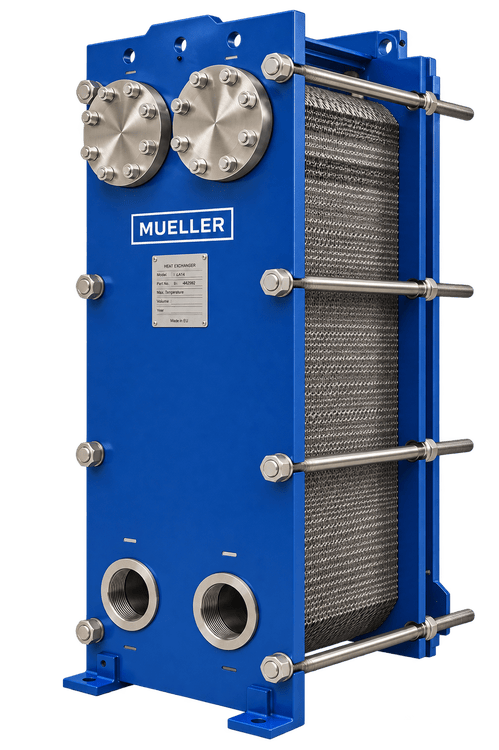
Accu-Therm Plate Exchangers
The original Accu-Therm, and the unit most of this line is built from. It handles simple fluids, viscous...
+ Learn More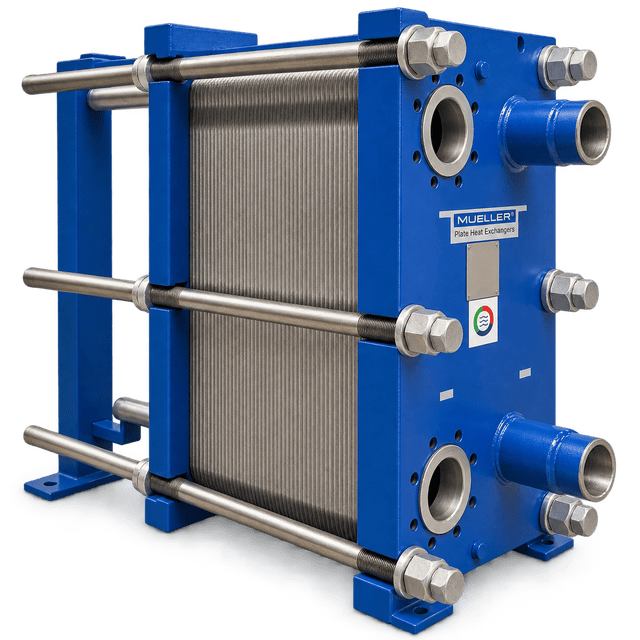
Semi-Welded Plate
Some fluids attack gaskets. Welding pairs of plates into cassettes puts those fluids inside a welded boundary...
+ Learn More
Free-Flow Plate
Conventional plates block on fibers and particulates. The Free-Flow plate opens the channel up, which lets it...
+ Learn More