
1-805-484-2992
Quotes - Engineering - SalesHEAT EXCHANGERS
Falling Film Chillers
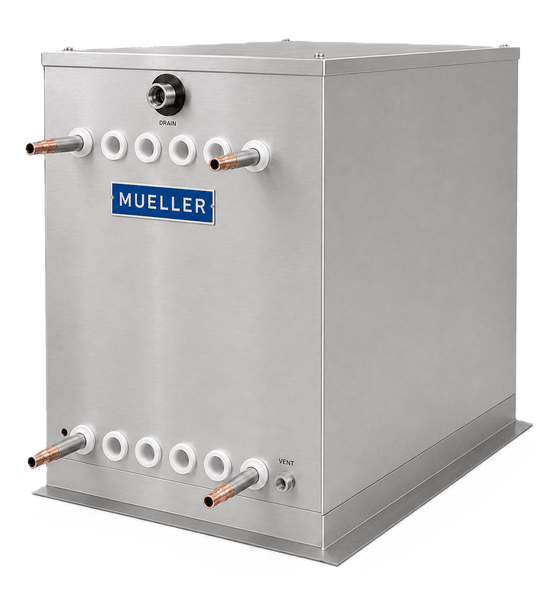
Water runs down the face of refrigerated Temp-Plate panels in a thin film and leaves near freezing. There is no secondary exchanger, no glycol loop in between, and the plate design means the unit does not freeze itself solid.
A falling film chiller distributes water across the top of a bank of Temp-Plate evaporator plates with refrigerant inside them. The water descends as a thin film, giving very high heat transfer, and collects in a sump or passes straight through on tankless models. Because the refrigerant is directly in the plate, there is no intermediate loop and no secondary heat exchanger to lose approach temperature across.
Part numbers. Every cataloged model, with the dimensions and ratings that separate them: Falling Film Chiller Model Range (17 part numbers).
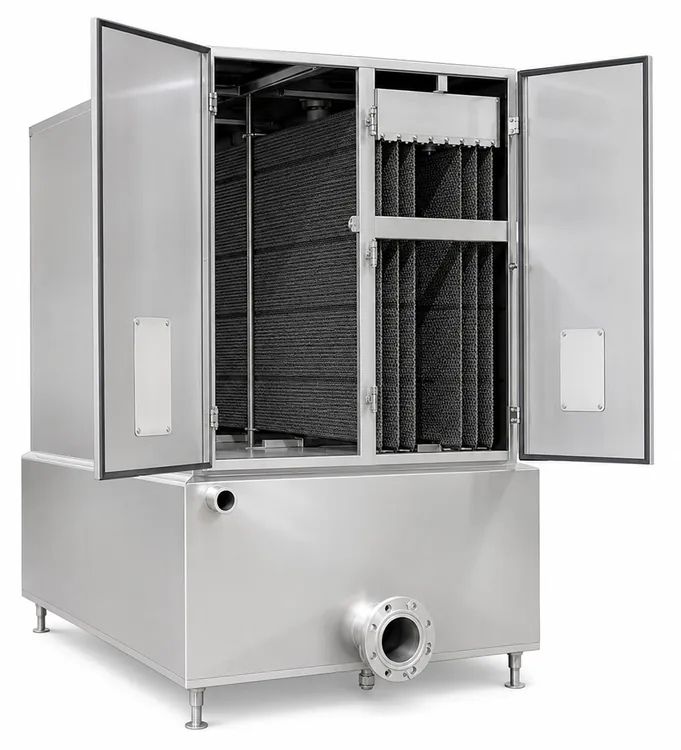



- No freeze-up. The Temp-Plate evaporator design is what prevents the chiller freezing solid, which is the classic failure of ice-builder style equipment.
- No secondary exchanger. Refrigerant is in the plate and water is on it, so there is no glycol loop and no second temperature approach to give away.
- Fully enclosed. The cabinet keeps airborne particles out of the water, which matters wherever the chilled water touches product.
- Easy to clean. Plates and distribution are accessible, so sanitation is a routine task rather than a shutdown.
- 3x5 and 4x8 plates. Two evaporator plate sizes cover a wide capacity range, with cabinets typically holding from four to twenty-four plates.
- Tankless option. Where the process already has storage, a tankless chiller removes the sump and shrinks the footprint.
Falling Film Chillers
Where Falling Film Beats a Packaged Chiller
A conventional packaged chiller cools a glycol loop, and that loop then cools your water through a second exchanger. Every one of those steps costs approach temperature, and approach temperature is what determines how cold your water actually gets.
A falling film chiller removes the middle step. Water is chilled directly on the evaporator surface, which is why these units reach lower water temperatures and why they are the standard answer wherever near-freezing process water is required.
Applications
Produce and vegetable hydrocooling, bakery ingredient water, brewery liquor cooling, ice water for meat and poultry processing, sweet water systems and general process chilling all use falling film chillers.
The common thread is a need for water at or near freezing, in volume, delivered reliably and cleanly. Where the water contacts product, the enclosed cabinet is part of the specification rather than a convenience.
The Dedicated Chiller Site
Complete rating tables, accessories, controls and the full selection guide for every model in this range live on our falling film chiller site: FallingFilmChillers.org. Start here to narrow the cabinet, go there for the numbers.
Related
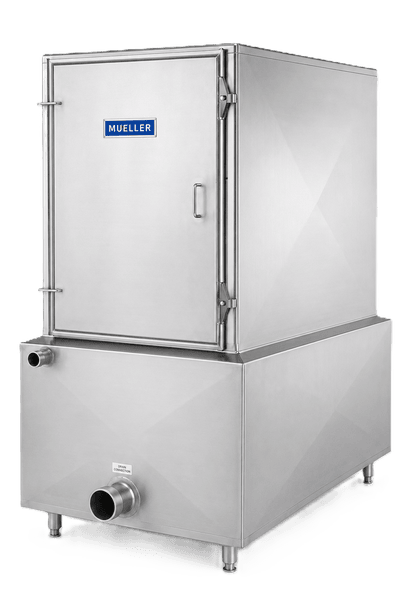
3x3 Falling Film Chiller
The smallest cabinet in the range, and the one that fits where floor space decided the specification: a...
+ Learn More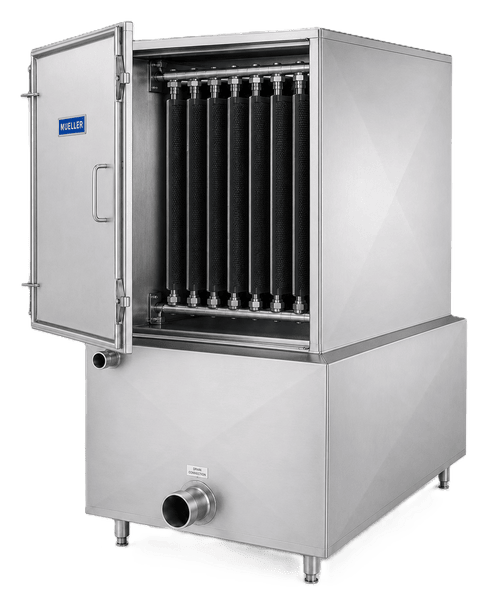
3x5 Falling Film Chiller
The smaller of the two evaporator plate formats, and the one that covers most bakery, brewery and mid-size...
+ Learn More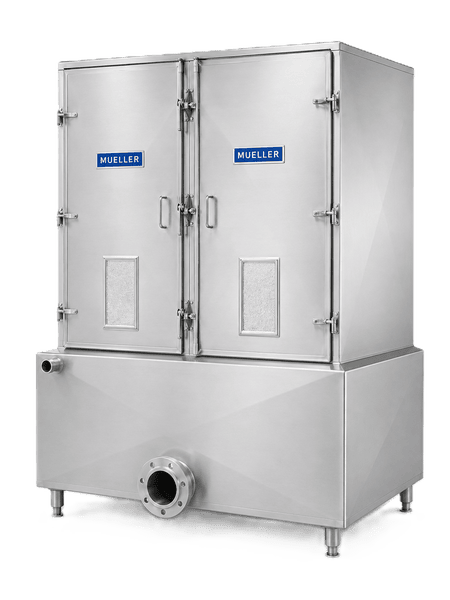
4x8 Falling Film Chiller
The larger evaporator plate format, for duties where a 3x5 cabinet would need more plates than it can hold or...
+ Learn MoreSelection questions
Start with the room. If the space is tight and the flow is modest, the 3x3 cabinet with its own tank is the place to begin. Mid-size bakery and brewery duty usually lands on 3x5, and large hydrocooling or poultry systems move to 4x8, where fewer plates reach the capacity. Then check the doorway and ceiling height against the cabinet.
Each heat transfer step in a glycol system gives away a few degrees of approach, and near freezing there are no degrees to spare. Water on a falling film plate touches the refrigerated surface directly, so it can leave far colder for the same suction temperature. The glycol route still makes sense when the water target is well above freezing.
Water moves down the plate in a thin, continuous film and leaves before it has time to freeze. The inflated plate surface has no flat dead zones where ice can anchor and grow. Control of the suction temperature matters too, so the refrigeration side is set up with the chiller rather than chosen separately.
Any process that needs large volumes of water close to freezing. Hydrocooling of produce, chill water for meat and poultry, bakery dough water and brewery liquor are the familiar ones. Sweet water systems and general process chilling also suit it, especially where the water touches food and the enclosed cabinet becomes part of the hygiene case.
The cabinet opens so the plates and distribution pan can be reached and washed down with the unit shut off. The plates are fully welded stainless Temp-Plate with no gaskets, so residue has few places to hide. Build the washdown into the production schedule and fit a floor drain near the cabinet, because sanitation is far easier when the water has somewhere to go.